Showing posts with label Equipment Reviews. Show all posts

Wednesday, June 3, 2015

Gun Review: Glock 43 Singlestack 9mm

In this article, I will review the new Glock 43 Singlestack 9mm pistol. Through the course of the text and photos, I will provide an overview, discuss the Fit, Function, and Finances in regard to this model, and then conclude with a Range Report and personal observations.

Whether you love ‘em, hate ‘em, or have chosen to ignore them since their introduction in 1982, there is no doubt that Glock pistols have made their mark on the firearms and shooting industries. Designed in 1981 by Austrian engineer and polymer tool pioneer, Gaston Glock, the Austrian Army commissioned the 9mm Glock 17 in 1982. The venerable G17 was introduced into the U.S. in 1985 and its simple operation and extreme reliability immediately caught the attention of Law Enforcement and commercial markets.
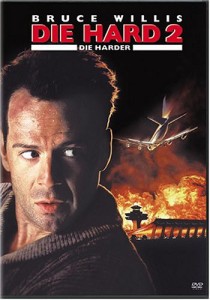
G17 gained near-instant fame when Bruce Willis incited a myth about Glock 7 in Die Hard2
However, it wasn’t until 1990 that the G17 gained near-instant fame when Bruce Willis (playing the role of John McClane in the second Die Hard movie) incited a myth when his character stated: “That punk pulled a Glock 7 on me. You know what that is? It’s a porcelain gun made in Germany. Doesn’t show up on your airport X-ray machines, here, and it cost more than you make in a month.” Although the dialogue is factually incorrect in nearly every account, it launched a legend. (there is no Glock 7, no parts are made of porcelain – the slide is steel while the frame and some small parts are polymer, it most certainly WILL show up in an X-ray machine, and even in 1990 dollars, it didn’t cost more than the other character made in a month)

Since the company’s founding in 1981, they produced their 5 millionth pistol in 2007 (source: https://us.glock.com/heritage/timeline) and it is estimated that Glocks dominate 65% of the U.S. Law Enforcement market (source: Sweeney, Patrick (2008). The Gun Digest Book of the Glock (2nd ed.).

Iola, WI: Krause Publications).
Built on a foundation of extreme reliability, affordability, and superior function, Glock expanded their line of pistols to include a myriad of calibers, slide lengths, and frame sizes to accommodate a wider variety of law enforcement, military, recreational shooting, personal defense, and competition markets. Although it is a fine handgun for personal defense, concealed carriers often lamented the sheer width of even the “smallest” Glock models. Let’s call it what it is… the majority of the line-up can be best described as “boxy” and difficult to conceal.

A New Era?

During this year’s SHOT (Shooting, Hunting, and Outdoor Trade) Show, Glock unveiled the Glock 42… a Single-Stack (read: thinner) sub compact handgun chambered in .380 auto. Many flocked to the new offering with abounding joy while others decried the marginally performing .380 auto designation while crying: “if they only made it in 9mm!”

Well… the shooting world waited 27 years for a single-stack Glock, so the mixed emotions stemming from the Glock 42 turned into rapturous joy a few short weeks later in mid-April when Glock unveiled the G43 at the NRA Annual Meeting held in Nashville, Tennessee. Finally, the shooting community had its Glock single-stack sub-compact chambered in 9mm!

Aegis Academy Pistol Training in San Diego


Introducing the Glock 43


Even though the sub-compact carry-pistol (or pocket pistol) market left little room for another entry, the Glock 43’s introduction was heralded with fanfare and eager anticipation. For weeks after its introduction in Nashville, gunshops around the country were flooded with requests and inquiries: “so… when WILL you get one in stock?” In most cases, they departed through the front door of the shops within hours of hitting the receiving dock. A few internet entrepreneurs on Gunbroker and Gunsamerica were taking advantage of the flurry of activity by charging premium prices exceeding the $600.00 range.

Although I’m generally lukewarm to Glocks and use either a customized 9mm Glock 34 for competitions or the G17 and G19 for instruction, I was also caught-up in the excitement about the new single-stack offering. I managed to purchase a Blue Box (military and law enforcement sale) for a little over 4 bills and I’m impressed with its fit and function.

By the numbers, the Glock 43 has an overall length of 6.26 inches, barrel length of 3.39 inches, height of 4.25 inches, and width of 1.02 inches… all with an unloaded weight of just under 18 ounces. All other features of the Glock 43 remain both similar and true to the original design… including the plastic “front dot” and “rear U-notch” sights.

The traditional Safe Action trigger initially measured a little over 7 pounds using a wheeler trigger-pull scale. However, after firing 500 rounds and conducting a thorough cleaning, the same scale measured closer to the advertised 5.5 pounds. Trigger travel and positive re-set are similar to other Glock models.

The pistol ships in the standard hard case with a gun lock, polymer cleaning rod and brush, magazine speed loader, and two magazines. Both magazines can hold 6 cartridges, but one is flush and the other has a finger extension.

Taking a closer look


The Glock 43 both functions and breaks-down in a manner nearly identical to the flagship G17. Also, the internal parts are NEARLY identical. The two most notable differences can be found in the dimensions and shape of the safety plunger and the tip of the striker. The photos depict the visual differences. Continue Reading »
 
Author - Howard Hall

Disclaimer: I have no personal or professional connections to Glock or its affiliates and I was not compensated in any way by them for this review. I purchased the pistol through a military and law enforcement retailer. The observations and opinions expressed are mine alone provided for your information only.

Thursday, March 5, 2015

Gun Review EAA Windicator .38 Special/.357 Magnum Revolver


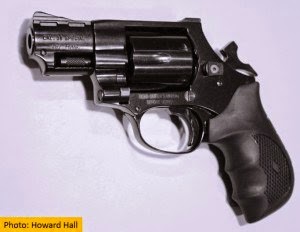
EAA Windicator .38 Special/.357 Magnum Revolver
In regard to the third “F” in Fit, Function, and Finances… does a quality gun necessarily have to be expensive? We’ll take a look at that question in this review of the EAA Windicator .38 Special/.357 Magnum Revolver.
Aside from the firearms I’ve used in conjunction with my military career, I’ve spent my “other” shooting career focused on firearms for competition, sporting, and personal defense. As such, I’ve spent only a fraction of that time shooting revolvers. I have noted, however, that a growing number of clients are interested in learning about revolvers for per395087sonal defense. snake-shot,
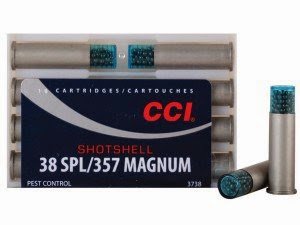
ShotShell 37SPL/357 Magnum
which cannot be fired through semi-automatic pistols. I must admit that I have also become increasingly interested in carrying a revolver for camping or while out at the cabin due to their durability, reliability, and wide variety of ammunition, which includes

I discussed this topic with one of my friends who works at Cabela’s in Hamburg, PA and mentioned that I was in the market for a rugged snub-nosed .38 special/.357 magnum revolver that could fit my large hand. He showed me a wide variety of revolvers from Ruger, Smith and Wesson, and Taurus that ranged from $450.00 to $900.00. Since I was only going to incorporate this revolver into basic firearms instruction and the occasional camping trip or weekend at the cabin, I challenged my friend to find one that met my specifications at or below $300.00. After a few minutes, he presented me with the EAA (European American Arms) Windicator, which is a 2 inch snub-nose blued revolver in .38/.357… for under $300.00!

Although it was a small 2 inch snub-nose, this revolver felt solid and the generous grip filled my large hand quite well. A cursory inspection verified that the lock-up and timing were acceptable. Dry-firing verified that the double action trigger pull was long and heavy compared to the short and light single action pull. Everything checked-out at the counter, but I wanted to do a little more research before committing to the purchase.

Over lunch, I looked-up everything I could find on the EAA Windicator. European American Arms (EAA), based in Florida, has been importing this revolver from a German company named Weihrauch for quite some time. The reviews spanned the gamut from “phenomenal” to “worthless.” A few reviewers cited their revolver losing its timing after firing thousands of high pressure .357 rounds or claiming that it was insufficient for IDPA shooting. Many reviewers cited that it was a great bargain for the price.

Since my expectations and intended usage were more in line with the price point than those who expressed disappointment in their reviews, I purchased the revolver, a few boxes of American Eagle .38 Special ammo, and set out to test it and form my own opinions. With the help of my friend, Al Rice, we put the Windicator through its paces at Sharpshooters in Lorton, VA.

By the Numbers


Six-shot single action / double action revolver
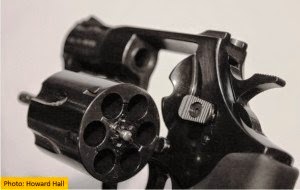
The EAA Windicator is a 2 inch snub-nosed six-shot single action / double action revolver chambered in .38 special and .357 magnum. Its fixed sights are comprised of a plain black ramp blade in the front and a plain “U” shaped fixed channel in the back. The overall length is 7 inches. This revolver has a substantial black rubber grip and weighs 30 ounces (nearly 2 pounds) empty! This is significant when you compare it to some of the popular snub-nosed .38/.357s like the Ruger LCR weighing-in at 17 ounces and the comparable Taurus and Smith and Wesson models weighing in at roughly 20 ounces (and with MSRPs from $500 to $700). The double action trigger pull exceeded the 10 pound limit on my spring-scale, but the single action pull registered a consistent 4 pounds across six tests.

Fit


As mentioned above, the Windicator’s grip was substantial enough to fill my hand, but was not so prohibitively large that a shooter with a smaller hand couldn’t establish a sufficient and comfortable grip. This revolver pointed naturally and the “length of pull” (distance from the back-strap to the trigger face) was appropriate for me to place the pad of my index finger where it belonged for a smooth trigger pull. From a double action start, the length of pull measured 2.525 inches and the sear broke at 2.105 inches, which means that 10+ pounds of steady pressure had to be applied throughout the trigger’s 0.420 inch travel. Conversely, cocking the hammer for a single action shot reduced the length of pull to 2.170, which leaves the shooter to apply 4 pounds of pressure over a very short 0.065 inch to break the shot.

Function


Again, I chose this revolver as a training aid for basic firearms instruction and as a utility firearm while camping or at the cabin. As such, the 2 inch snub nose makes it ideal for the classroom and the field. Also, while many new revolver designs for concealed carry are double-action-only “hammerless” (where the internal hammer has no exposed spur), I needed a DA/SA revolver with exposed hammer and spur for instruction and to provide the option of a heavy and deliberate double action or planned and light single action shot. Read More »

About Author: Howard Hall (Range Master)


Howard has served for nearly 20 years in the Marine Corps. He has served as a Platoon Commander, Company Commander, Battalion Executive Officer, Regimental Operations Officer, and Battalion Commander. He has multiple combat tours to include serving as a military transition team member in Fallujah. He is an NRA Certified handgun instructor and holds numerous Marine Corps training credentials.
An active competitor in action pistol (United States Practical Shooting Association), long range rifle (NRA F-Class), and shotgun (Amateur Trapshooting Association, National Skeet Shooting Association), howard has earned numerous accolades and medaled during DoD competitions with the 1911 platform in bulls-eye shooting.

Tuesday, January 27, 2015

Product Review: Smith and Wesson M&P 9mm Pistol

Smith and Wesson M&P 9mm Pistol Gun Review
In this article, I will provide a product review and range report on the Smith and Wesson M&P 9mm pistol as both a general equipment review and as information on an Aegis Academy rental gun. To set the proper context, let’s start with a little history.


History


In 1982, Glock took the firearms market by storm when it introduced a durable and highly reliable polymer framed pistol with its unique “safe action” trigger. Shortly after the Austrian Police adopted the 9mm Glock 17 as its duty sidearm, military and police forces around the globe either adopted or strongly considered this venerable platform. In the years that followed, many other pistol manufacturers rushed to regain this valuable corner of the firearms market.
For decades, Smith and Wesson revolvers and semi-automatic pistols had been long-favored sidearms for U.S. law enforcement. Adapting to law enforcement and consumer trends, S&W threw its hat in the polymer-framed pistol ring in 1993 with the “Sigma.” However, the Sigma design shared so many similarities with Glock that the subsequent lawsuit for patent infringement was eventually settled out of court in 1997.

Adapting to the ever expanding polymer-framed pistol market and aggressively seeking to enter into military contracts while also regaining a foothold in law enforcement circles, S&W introduced the M&P, or Military and Police, pistol line in 2005 with the M&P 9mm. Since then, they have expanded the line to include full-size, mid-size, compact, competition, shield, bodyguard and revolver models in 40 S&W, .45ACP, .357 Sig, .380ACP, and .22 Long Rifle. The M&P moniker has also extended to .357 Magnum/.38 Special M&P revolvers.

General Description


The S&W M&P pistols are polymer-framed, striker fired, short recoil operated, semi-automatic breech-locking pistols. This design incorporates an inertial striker safety which prevents the striker from moving forward and igniting the primer due to pistol momentum alone. This passive safety is disengaged only when the shooter depresses the trigger to initiate the firing sequence. The original models had no active or thumb safeties, but later models include this as an option. Other options include a magazine safety which prevents the pistol from firing while the magazine is removed as well as an integrated ignition system lock.

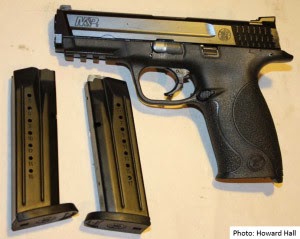
Smith and Wesson M&P 9mm Pistol Gun Review Breakdown
Other common design features include an integrated Picatinny rail to mount lasers or lights, ambidextrous slide lock, reversible magazine release, aggressive forward cut rear-cocking serrations, steel low mount “three-dot” or tritium sights, external extractor, loaded chamber indicator, and interchangeable back-straps to adjust to different hand sizes.

The action is a bit interesting. Most striker-fired pistols are considered single action since the slide recoil sets and locks the striker in a position ready to fire and the next trigger pull releases the striker to only move forward… thus single action. However, slide recoil in the S&W M&P sets and locks the striker 98% to the rear. The next trigger pull completes the remaining 2% movement to the rear before the sear releases the striker to move forward. Therefore, the S&W M&P is considered a striker-fired Double Action Only pistol. (Source: Smith and Wesson)

Ergonomically speaking, the bore axis is very low and an extended grip tang provides exceptional “guidance” toward a proper grip while drawing from the holster as well as recoil management during rapid fire.

S&W M&P 9mm Full Size Specifications


The pistol tested in this product review is the same model as the Aegis Academy rental gun. Actually, it IS one of the Aegis Academy rental guns. The Smith and Wesson web site lists this pistol’s attributes as follows:

  • Caliber – 9mm
  • Barrel Length – 4.25 inches
  • Sights – steel, low mount, three dot fixed sights
  • Trigger Pull – 6.5 pounds
  • Overall Length – 7.3 inches
  • Overall Height – 5.5 inches
  • Width – 1.2 inches
  • Sight Radius – 6.4 inches
  • Weight (empty) – 24 ounces
  • Finish – Black (frame: polymer; slide: melonite)
  • Capacity – two 17-round magazines


Analysis


I am very familiar with the M&P pistol line. I purchased a full-size M&P .45ACP in 2011 and used it extensively in USPSA (United States Practical Shooting Association) competitions in the Production Class through 2013. I have also used the full-size M&P 9mm on the range during instruction with Aegis Academy. In the following paragraphs, I’ll review the fit, function, and finances of the full-size M&P 9mm.

Fit – I found the full-size frame to be well suited to my large hands… even with the “Medium” back-strap insert installed. Aegis clients with smaller hands appreciated the option to “go down” one size and have the small back-strap insert installed. However, those with the smallest hands did occasionally have trouble gaining a “high grip” to ensure the tang sat snugly against the web between their thumb and forefinger. For most shooters, this pistol points naturally and the combination of the low bore axis and the extended grip tang made it easy to get the first shots on target while keeping the recoil manageable for rapid follow-up shots as well.

I personally appreciated the extended grip tang… especially when drawing from the holster. Again, with large hands, this is my main complaint with Glock pistols: overgripping the frame and getting “bitten” by the slide. Read more >>

Posted by Howard Hall