Showing posts with label news. Show all posts

Wednesday, September 10, 2014

DOS vs. ISIS – The war of Ideas


The U.S. Department of State vs. ISIS - The war of Ideas


ISIS Recruiting - Think again turn away

While I was still on active duty, I witnessed some of the severely incompetent planning, policies and execution by the Department of State (DOS). De-Baathification, disbanding the Iraqi Army, rebuilding Fallujah and the use of contractor vice uniformed military details for standard security operations are but the tip of the iceberg. Their inability to adapt over the course of a decade at war in Iraq and Afghanistan, and their arrogant adherence to bad policy was, and continues to be staggering. Their latest foray into anti-ISIS propaganda was a video titled, Welcome to Islamic State Land. Like much of the entire Think Again, Turn Away program, it waivered between sarcasm, attempts and humor and grisly depictions of inhumane activity. It is indicative of the colossal gap between how the DOS views ISIS and what ISIS is actually trying to achieve. Here is their anti-recruiting video, and below are some samples of ISIS recruiting videos.

Warning Graphic Content:


Most young males in their early life, rightly or wrongly, grow up judged to a large extent based on their physical prowess. Those who are not physically skilled have to find others means of competing. Humor, intelligence, emotional IQ, etc.. become more important as we age especially into the teenage years and on to adulthood. Over time, raw physical ability becomes less and less important. Some successfully make the transition, some spend their lives competing in the physical area, and some do a bit of both. In the gap between those who create their identity via physical prowess and those who create their identity based on other skills is subset of the population who simply does not fit. Some of them will find their path later in life and be truly impactful; others will simply accept their place with resigned frustration.

A small subset of that population will come to resent what they see as a society that does not value them as individuals. This particular subset of young adult males is likely to feel powerless against what they view as an oppressive society. Some will independently lash out at home and commit petty crimes or worse (Elliot Rodger, Adam Lanza, etc…). Others drift to the fringes of society and live out a comparatively isolated existence. These fringes are the population of society that ISIS is targeting with its western recruiting efforts.

The Department of State’s Message to would be Jihadists:


The video starts with people being shot, tossed from a cliff and beheaded while the leader of ISIS proclaims “Syria is no longer for Syrians, Iraq no longer for Iraqis”. What the Majority of Americans see is brutality at the hands of a terrorist organization, and human beings who need to be defended from oppression and abuse. That video may be an effective means of raising awareness of the brutality to ISIS, but to those who are considering ISIS as a means of lashing out at the society who has shunned them, it is exactly the opposite. What they see is a minority of righteous followers who have seized power from an oppressive society and are exacting their revenge under the banner of a higher cause. ISIS is largely depicted in the video as acting at will and as all powerful in their area of control.

The scenes of abuse continue, and cements in their minds that ISIS can do whatever it wants to not just people, but religious institutions, organizations and governments. Worse yet, they take an almost sarcastic approach to closing in saying “Travel is cheap because you won’t need a return ticket”. I am not sure if that is intended as a threat – but all the would be recruit hears is sarcasm… Just like the sarcasm and the bullying that that they feel has marginalized them in society. “Think again, Turn Away” is the final message which will be perceived as a society, which has rejected them, attempting to keep them in their current condition – marginal and irrelevant. This video practically does ISIS’s job for them.

The ISIS message to would be Jihadists:


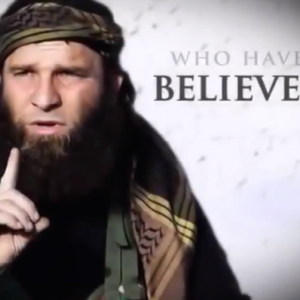
When we contrast that with the videos produced by ISIS, they communicate a very different message. First, there are no messages of what not to do, but messages of joining a cause that is larger than yourself. It is an inclusive message of acceptance. The choice of western recruits is also well made. This is not the captain of the football team, these are smiling young men, who could be anyone. Every day people who may even be exactly the the type of people who might not fit in at home. Below are some short samples from There is no life with Jihad, one of the ISIS recruiting videos targeting westerners to which you can compare the messages.


When we view the clip of western males talking about their experience, these are not the popular kids in school. The speakers do not appear exceptional in any way. The subtle message is – Any of you, can be one of us. They visually display the symbol of power they possess with the constant images of a gun in the frame. They are positive in their choice of words and message. Join us, come to us, fight for something that matters. The message is: join our team; we will accept you, everyone is capable. They are not communicating a message of what not to do, they are communicating a vision of what you can be a part of.

Through most American’s eyes, we see ISIS behavior as twisted. ISIS is not recruiting most of America. We have recently taken a look at the execution videos of James Foley and Steven Sotloff. There we see an even starker image portrayed to the Muslim world and both speak volumes to potential recruits. To review the highlights: both theses videos convey that ISIS is the victim of western aggression, ISIS is firmly in control of its lands, even American ISIS victims agree with their “punishment”, and that ISIS is energetically moving forward, while American leadership is portrayed as defeated.

When we contrast the ISIS message of “You can join a successful cause, greater than yourself, that will give you the power to exact revenge on the society that does not value you” with “Think again, Turn away” it does not take rocket science to understand who is winning the war of perception – in the eyes of the target population.

As long as we view ISIS through an American lens, we will fail to check their pursuit of their goals. The intelligence community has experts who could produce videos that could both insulate the target population from infection, and deter potential recruits. Clearly the DOS in its arrogance did not bother to seek them out. They continue to steadfastly view the world and ISIS through an American lens. That view is as ineffective at checking ISIS goals as is the video they produced. In the U.S. Department of State Vs. ISIS – the war of ideas is what fills their armies, and the DOS is grossly unprepared to fight it.
We are not at any more significant risk from ISIS in America than we were six months ago, however, if this ineffective bumbling approach to dealing with ISIS does not change, we one day will be.

About Author


Patrick Henry - President at Aegis Academy

Patrick Henry
Patrick Henry received his operational training and experience from the U. S. Government, 22 years of which were spent in the Marine Corps where he served in the Reconnaissance, Infantry and Intelligence fields. During his active service, he spent more then seven years deployed overseas in combat, operational and training assignments. After the military, Pat worked as a contractor and as the Director of Operations at a private paramilitary company, specializing in training special operations forces and providing protective services to select private clients. His education consists of an MBA from the University of Southern California (USC), and a BS from San Diego State University with an emphasis in Biochemistry, Cell and Molecular Biology and a minor in Psychology. He holds an extensive list of security and training related certifications from a variety of government and nationally recognized entities. He currently sits on the advisory committee at USC’s Master of Veterans Business Program, and is an active member of Infraguard and the American Society of Industrial Security (ASIS). He has been a guest speaker at ASIS, the San Diego Industrial Security Awareness Council and other private organizations on physical security, travel security, and competitive intelligence collection counter-measures.

First Published at Aegis Academy

Thursday, September 4, 2014

The Beheading of Steven Sotloff

As with the murder of James Foley, the video production is smartly produced, well scripted and designed and is intended to the tell Muslim world that the “Islamic State” is in control. If you have not read the analysis of the James Foley beheading, I would encourage you to do so first, as it was the precursor that set the stage for this second production. Once again, I do not recommend that you watch the video as you will merely witness the brutal murder of a helpless human being. There is, unfortunately, an underlying sophisticated message that is well communicated.

This video also starts out with a clip of President Obama responding to the James Foley beheading stating “America will continue to do what we must.” Not what we should, not what is right, not what he wants to do, but what “we must.” Despite his typically clear and engaged speaking style, ISIS has again chosen a clip in which Obama looks tired and emotionally disconnected from the message. They could not have chosen a clip in which he looks more reluctant or hesitant. This is not a critique of Obama, as that speaking style is not his norm, and certainly there are clips in which he does not appear defeated and or exhausted. From their perspective, this was again an intelligent choice visually portraying the leader of the free world as weak, unsure of him-self and/or reluctant.

At the end of his remarks Obama states that America is “standing alongside others.” ISIS directly addresses this statement in their closing remarks. This message is titled a Second Message to America, and opens with Mr. Sotloff introducing himself with his full name and states “you probably know who I am by now.” This reference is explained when we look at U.S. and western news reporting of Mr. Sotloff as the “forgotten journalist” shortly after the James Foley beheading. He would be highly unlikely to make a general assessment that people did not know of his plight on his own.

Mr. Sotloff calmly and succinctly makes the case that Obama’s foreign policy is not meeting its endstate and asks why he is having to pay with his life stating “Am I not an American citizen?”. This is intentionally designed to draw a distinction between America and Obama to the Muslim world. They saw what happened when Bin Laden attacked America, and what a united America is militarily capable of. ISIS has been diligent in tying its actions to Obama and his policy and in attempting to claim that those actions do not represent the will of the American people. His last sentence is an emotional appeal to the audience that America’s foreign policy is failing as evidenced by its inability to protect him.

He addresses the broader failure of American foreign policy in the region citing thousands of lives and billions of dollars lost “fighting the Islamic State.” This statement is intended for the Muslim audience who largely see Iraq as an American defeat. ISIS is telling Muslims that they were responsible for America’s defeat. He closes this paragraph ending in “So where is the American people’s interest in re-igniting this war?”. This again emphasizes to the Muslim world that America is not united with the actions of it leadership.
Mr. Sotloff then goes on to reference the campaign promises of Obama during his first and second presidential campaigns (Iraq, Afghanistan and Guantanamo). He states “nearing the end of your term having achieved none of the above” starkly pointing out the lack of stated campaign achievements in a further attempt to distance American air strikes from American support to their Muslim audience.

As with Mr. Foley, Mr. Sotloff is far too calm for a person who believes his execution is at hand. He speaks with a measured tone; he sounds tired and speaks with the pace of one who is almost bored with his rehearsal. This is probably due to excessive repetition, as I did not see any similar indicators of fatigue in Mr. Foley’s speech prior to his murder.

The camera cuts to another energetic, engaged speech by what appears to be the same murderer from Mr. Foley’s video. He states “I am back Obama… because of your arrogant foreign policy” again opening with a statement attempting to emphasize that the actions of the administration do not align with the American peoples interests. He references specific airstrikes, many of which occurred prior to the beheading of James Foley which could indicate this video may have been produced shortly after the Foley beheading.

If Mr. Foley and Mr. Sotloff were held in proximity to each other, he would have noticed his absence in the past two weeks. It is unlikely that he would have been able to make the assumption that he was not dead. It is quite possible that they were not held together, but alternatively, based on the Mosul Dam reference, this and the next few executions may have been filmed in the past.

The physical contact between the murderer and Mr. Sotloff does not evoke the response of a person who thinks they are about to be decapitated. In fact, when his murderer grabs his chin, he appears to relax, which is indicative of someone not expecting to experience pain. This would only occur with repeated practice and extensive conditioning. At the point Mr. Sotloff’s murderer begins to cut he attempts to stand, which is the only indication of resistance that we see before the screen cuts to black.

Again, there are no screams of Allah-u-Akbar, references to god or religion, no arterial bleeding, or other gore to disconnect the viewer from the message. The entire video is presented in an almost transactional manner. The next scene is Mr. Sotloff’s head laid out on his stomach. Similar to Mr. Foley’s who’s head was placed in the center of his back. The blood is dark and has started to congeal indicating there has been a considerable amount of time between the murder and the final pan across the decapitated body.

The last scene is of a British citizen, David Cawthorne Haines, in an orange jumpsuit at the feet of the Islamic State’s Murderer. He addressed Obama’s “Standing along side others” comment with “We take this opportunity to warn those governments that have entered this evil alliance of America against the Islamic State to back off and leave our people alone.”

The key emotional components that ISIS wants to communicate to the Muslim world is Obama’s weariness juxtaposed with the enthusiasm of the Murderer who, to the intended audience represents the Islamic State. They are attempting to demonstrate that Americans have a resigned acceptance of their fate – even at the moment of their death. They continually attempt to separate American actions from the will of the American people so as to avoid what is largely viewed in the Muslim world as Al Qaeda’s primary mistake.

The message is designed to communicate three themes. First , there is a deep wedge of dissatisfaction between America and the administration giving hope that we may again abandon our chosen course. Second, to demonstrate to the Muslim world that America is powerless to stop the Islamic State from pursuing its goals. Third, the Islamic State is still in control and will continue to pursue its objectives regardless of American air-power. This video is designed to instill confidence in the longevity of ISIS.

The beheading of Steven Sotloff was not a message to America, it was a second message to would be jihadists who have yet to join the cause.
Our prayers to the family of the most recent victim of ISIS.

About Author


Patrick Henry - President at Aegis Academy

Patrick Henry
Patrick Henry received his operational training and experience from the U. S. Government, 22 years of which were spent in the Marine Corps where he served in the Reconnaissance, Infantry and Intelligence fields. During his active service, he spent more then seven years deployed overseas in combat, operational and training assignments. After the military, Pat worked as a contractor and as the Director of Operations at a private paramilitary company, specializing in training special operations forces and providing protective services to select private clients. His education consists of an MBA from the University of Southern California (USC), and a BS from San Diego State University with an emphasis in Biochemistry, Cell and Molecular Biology and a minor in Psychology. He holds an extensive list of security and training related certifications from a variety of government and nationally recognized entities. He currently sits on the advisory committee at USC’s Master of Veterans Business Program, and is an active member of Infraguard and the American Society of Industrial Security (ASIS). He has been a guest speaker at ASIS, the San Diego Industrial Security Awareness Council and other private organizations on physical security, travel security, and competitive intelligence collection counter-measures.

First Published at Aegis Academy

Monday, August 25, 2014

Is ISIS the future of Islam?

Is ISIS the future of Islam
Western leadership has denounced the beheading of James Foley, and both Obama and Blair have referred to ISIS as a “cancer”. Cancer is probably the most accurate analogy of what Islamic extremism really is to Islam as whole. The real question we need to ask is if we can treat it? In making that determination in a cancer patient, we would look at the location of the cancer, the growth rate and the degree of metastasis of the infection. For diseases, we would also like to know the vector (or mechanism by which it spreads). We have metrics to measure these all of these components of extremist Islam.

The National Counter Terrorism Center (NCTC) released an unclassified version of their 2011 Report on Terrorism, which shows that 56% of total attacks can be attributed to Sunni Islamists. They are also responsible for more than 70% of total global terrorist attack deaths, which tells us that on average their attacks are considerably more violent than other terrorist groups. If we do not face the fact that there is strong correlation between terrorists, terrorist attacks and Islam, then we are choosing to ignore the statistical reality of the problem. If we continue to ignore the causal factors of the problem, we have very little chance of solving it.

Neither Islam nor the Quran independently create terrorists


Neither Islam nor the Quran is the cause of terrorism. One of the often-cited myths about Islam is that the Quran has Suras (Verses) which justify terrorism and that those equivalent versus are lacking in the bible. The first part of that sentence is true, the Quran is rife with instructions to do violence against non-Muslims. For example Sura 9.5, “God instructs his Muslim followers to kill unbelievers, to capture them, to ambush them…”. Sura 4.34, 5.33, 8.12 and 8.6 are pretty commonly used as examples directing what western society today would call torture.

The falsehood arises in the second part of the sentence when Christians conveniently ignore the equivalently violent passages in the Bible, (and the Jews in the Torah, specially the Tanakh). The passages are equally descriptive and direct the extermination of the Canaanites – effectively advocating genocide. Certainly there are many other references that could be select and used to justify cruelty and violence. To say that the justification for violence is more present in the passages of the Quran than in the bible or the Torah is simply false. Extremism is no more rooted in the holy book of Islam, than any other religion. We need to look to the culture of Muslim nations and determine how their interpretation of these versus creates such a high percentage of global terrorists.

Sunni terrorism is the primary driver of global terrorism


The NCTC report does not break out the Shi’a based terrorist attacks by groups from the total sum of “other” attacks. Shi’a Islam makes up only about 12.5% of the global population of Muslims. Therefore their total contribution to global terrorism is relatively low compared to their Sunni counter parts. Further, Shi’a based terrorism is typically associated with much more targeted attacks like political assassinations, kidnapping or car bombs. This is probably due to the controls imposed by Iran, the state sponsor of Shi’a terrorist groups like Hezbollah and others. As such, this is a significantly different driver of extremism and it should be treated separately.

According to a recent Rand study, (June 2014) “since 2010 there has been a 58% increase in Salafist Jihadi Groups” (One branch of Sunni Islam that advocates violence), “a doubling in the number of fighters and a tripling in the total number of attacks”. The total Muslim growth global rate is approximately 2.5% per year, but the growth rate of Salafist Jihad’is based on those metrics is nearly 20% per year. What we can take away from those two reports is that Sunni Islam is the main vector by which extremism is spread, and that it is spreading almost 10 times faster than the potentially healthy elements of Islam.

The attitudes of Muslims can be and have been tracked


When we look at the 2013 Global Pew Poll titled The World’s Muslims: Religion, Politics and Society, I want to point out the range of responses is wide. Different cultures certainly influence how Islam is practiced, and how extremism is viewed. It does however identify some significantly frightening points on the compatibility of Islam with other religions.

One key difference is highlighted in Appendix A which shows that American Muslims are considerably different from their global counter parts in their tolerance of other religions (They are off the scale and considerably more tolerant). In all other aspects of their religion, they are within the range of responses from their global counter parts. Religious tolerance is both a legal necessity to live in America and the only socially accepted position in American society.

That said, this uncharacteristic American Muslim tolerance of other religions, provides Americans with a distorted view of Muslim tolerance as a whole. American culture demands acceptance of other religions and this fact coupled with American Muslims being exceptionally tolerant undoubtedly helps create the American misconceptions that Islam is a tolerant religion and that acts of terrorism are not highly correlated with the Islamic faith. The fact is that Islam is generally intolerant, and Islam is highly correlated with terrorism, but that is socially unacceptable to say in America. These misconceptions created the illusion that there is no link, and the social norms stop Americans from identifying and discussing the root of the problem.

When we look at all other measures in the reported poll data, American Muslims are consistently similar to their global counter parts. One example of that similarity (which could be a measure of extremism as well) is their support for suicide bombing. Nineteen percent of American Muslims express support for its use. In the Muslim community at large 28% express support for suicide bombing. The American response falls well within the global range of responses.

As we saw in the video “A Message to America” which showed the beheading of American journalist James Foley, we can clearly see that influence in how it is practiced does not provide immunity from the infection. Another example is the Russian news agency requested poll from ICM research asking Europeans about their support for ISIS. Germany, the UK and France have about 2%, 7% and 15% respectively, of their total populations (Muslim and non-muslim alike) expressing support for ISIS. We can make the assumption that this support is coming primarily from the Muslim population, but clearly that is a surprisingly high number for western nations.

Next we can look back to the Global Pew poll, which looks at Muslim support for extremist groups. The global median of all Muslims who express an unfavorable view of specific terrorist groups in 2013 was as follows:
Al-Qaeda 57% / The Taliban 51% / Hamas, 45% / Hezbollah 42%
The question evoked responses of positive support, which globally ranged between of 13% – 32% of respondents. Very close to 25% of respondents refused to answer or stated they did not know. Less than half of the global population of Muslims sees the activities of those organization as incongruent with their religion. That tells me less than half of the Muslim population opposes the actions of the extremists.

Using our cancer analogy, if the cells of a human body were 25% cancerous and increasing at 20% rate per year, the chances of survival would be low. Applying those same growth metrics to the Ebola virus, if infections were growing at the same rate as extremist Islam, with its current slightly over 1,000 cases worldwide today and its two-week incubation, period we would have nearly 100,000 cases a year from now. Islam is neither a cancer nor a disease, but the extremist elements certainly have cancerous effect on the populations they engage with.

Can we stop the spread of extremist Islam?


Only recently, as ISIS started to threaten the political power in both Iraq and Syria, do we see Muslim governments starting to condemn their actions. It is neither surprising nor impressive that they are speaking out to preserve their power structures in the face of what is now a credible threat. The real power in the Middle East has always been tribal alliances followed by religious authority and only then do national governments and political power structures come into play. From a cultural perspective, Islamic governments have little or no ability to stem the tide of extremism.

Religious leadership would be the appropriate place from which to drive change. We can make the assumption that the Muslim population takes its cues and opinions from the religious leadership and the survey data largely reflects those views. Less than 50% state they are actively opposed to the actions of the extremists, so at best a consolidated push by Muslim Religious leadership would result in a draw… They are simply not on the same page.
ISIS on the other hand has clearly stated their goal. ISIS is in the media and on TV. ISIS is fighting a war with America to establish an Islamic State. ISIS confidently proclaims its leadership of the Muslim world. For many young Muslims, ISIS fighters are the war hero’s of their generation.

Conversely, Muslim religious leadership is talking, debating and arguing amongst itself. While a number of Muslim scholars have openly condemned ISIS actions, very few, if any, have condemned their goal of an Islamic State. Further, their messages are disjointed and they are simply not speaking to the Muslim community or world with a cohesive message. It is unwise to bank on religious leadership driving a successful shift in Muslim culture to one where radicalization and extremism is not tolerated. I see absolutely no indicators that a change of that magnitude is within their capability.

Barak Obama naively stated a few weeks back that ISIS is a Muslim problem and that Muslims must take the lead in solving it. In actuality this is a problem America created in 2003 by deposing Saddam Hussein. Until 2011 we were managing the problem we created and there was a chance to mentor the fledgling democracy that we had spent 9 years and 4,488 lives creating. In December of 2011, Obama’s “end” of the Iraq war left an incompetent military, and a disjointed, ineffective, non-representative government to figure it out on its own. ISIS was born in the Syrian conflict that Obama failed to engage in. It has swept aside the Iraqi Army he abandoned in 2011 and filled the power vacuum he created. ISIS is the surrogate son of Barack Obama and failed American foreign policy.

Setting aside blame, lets assume for a minute that Muslim governments do have the desire to solve the problem that America dumped in their laps. The only tool they have at their disposal is military force. We have seen how effective the Iraqi Army is, and quite frankly despite their clear incompetence in the face of ISIS; they are some of the better-trained and equipped soldiers in the region. Name one Muslim nation that credibly projects power beyond its own borders? Save Iran, there is none. Iran has absolutely zero incentive to do anything save ensure its own borders are secure at this point.

Military power alone will not change the future of Islam


We can use air power and Special Operations Forces and intelligence assets to delay ISIS from taking more ground. We cannot win a war via a delaying action. ISIS fighters are estimated at 17,000. Based on the past growth rate of extremism we calculated earlier, extremists are created at the rate of about 60,000 per year, which is certainly an adequate recruitment pool. ISIS is clearly benefiting from its new position as the dominant player in the extremist world and as such we can expect it to grow quickly.

We can probably keep a lid on it for a while, but air power is indiscriminate and every civilian casualty and non-combatant we kill increases the growth rate. SOF, air power and intelligence assets are not going to eliminate ISIS. If ISIS is a cancer, Muslims are militarily incapable of carving out the cancer themselves. From a practical perspective, western military power is the only force capable of performing the excision.

The excision of ISIS is not the issue. Like every Muslim army on the planet they are simply no match for U.S. military power. The problem is military power does not deal with the cultural elements in Islam that creates the extremists. If we are unwilling to go to war with the Salafist culture and the society’s it infects, then we should not go to war. We should in fact waste no more U. S. resources on fighting the symptoms and ISIS is only a symptom of the greater disease. The disease is not rooted in the Quran, or in a specific country. The disease is rooted in the culture surrounding a segment of the Islamic religion.

If America fails to clearly identify the root of the problem and create and lead the coalition to effect change, then ISIS is the future of Islam


As a country we currently lack the will to fight the protracted war in the Middle East against a significant potion of the Islamic religion. That is what it would take to eradicate extremist Islam. I am not sure how many beheaded Americans, bombed and attacked embassies, and terrorist acts on U. S. soil it will take to generate the will. What we do know is the Muslim world cannot independently solve the problem we created for them.

Under the Obama administration, ISIS has been handed the future of Islam, and until America generates the leadership and the will to fight extremism at is root causes, we will change nothing. Effecting change requires both the commitment of forces necessary and the strategic mission of eradicating the portion of Islam that is incompatible with the rest of humanity. Extremist Islam has been at war with America for quite some time. We have yet to declare war on it…

About Author


Patrick Henry - President & Firearms Instructor at Aegis Academy


Patrick Henry received his operational training and experience from the U. S. Government, 22 years of which were spent in the Marine Corps where he served in the Reconnaissance, Infantry and Intelligence fields. During his active service, he spent more then seven years deployed overseas in combat, operational and training assignments. After the military, Pat worked as a contractor and as the Director of Operations at a private paramilitary company, specializing in training special operations forces and providing protective services to select private clients. His education consists of an MBA from the University of Southern California (USC), and a BS from San Diego State University with an emphasis in Biochemistry, Cell and Molecular Biology and a minor in Psychology. He holds an extensive list of security and training related certifications from a variety of government and nationally recognized entities. He currently sits on the advisory committee at USC’s Master of Veterans Business Program, and is an active member of Infraguard and the American Society of Industrial Security (ASIS). He has been a guest speaker at ASIS, the San Diego Industrial Security Awareness Council and other private organizations on physical security, travel security, and competitive intelligence collection counter-measures.

First Published at Aegis Academy