Thank you for your continued interest in ballistics: the science of shooting! We have covered a lot of ground throughout this series in order to build to this last set of concepts and principles that will help you accurately and consistently place your shots on target. We will finish our discussion on External Ballistics by discussing Deviation, Gyroscopic Drift and Wind Deflection.
Deviation
The dictionary defines deviation as the difference between an expected and observed outcome or as the difference between the average outcome and a particular outcome. For our purposes, the “outcomes” are projectile impacts on target and a deviation is the difference between the point of aim and the point of impact or the difference between one particular impact and the rest of the group.

I first introduced the difference between mechanical precision and shooter accuracy in
Part II of our discussion on Internal Ballistics. If you recall, mechanical precision describes the capability inherent to the ammunition/firearm combination and their ability to consistently place projectiles in close proximity to one another, or in a tight group. Accuracy, on the other hand, describes the shooter’s ability to harness the mechanical precision and place a tight group focused within the intended area of the target.
While the Internal Ballistics Series focused primarily on mechanical precision and how to produce tight groups, External Ballistics has analyzed factors that affect the projectile’s flight to target. Whether it is a matter of precision or accuracy, the definition of deviation is applicable.
In regard to deviation, the most common measurement is Minute of Angle (MOA) to describe the distance between shots on target. I’d like to take a little time to discuss MOA to set the foundation for measuring deviation and better understanding Gyroscopic Drift and Wind Deflection.
Minute of Angle (MOA)
Any forces that affect a projectile’s flight become more pronounced the further the projectile travels. Stated differently, a small error will have little effect at close range, but a greater effect at a longer range. So, how do we characterize this in consistent terms? Since we are trying to measure the difference between terminal impacts from the same point of origin, this difference can be described as an arc, or more succinctly as an angle.
A full circle can be divided into 360 degrees, and each of these degrees can be divided into 60 minutes. Without taking you on too much of a tangent, this terminology came from the ancient Sumerians in the 3rd Century, B.C.. In order to track the distances or movements of celestial bodies in the night sky, they developed the sexagesimal system of measurement. Using this “base 60″ system, they subdivided each of a circle’s 360 degrees into a subdivision of 60 minutes per degree and this system is still in use today. Talk about longevity!
Many of you who have heard that 1 MOA = 1 inch at 100 yards; 2 MOA = 2 inches at 200 yards, and so on. This is MOSTLY true. Let’s take a closer look and start with calculations at 100 yards.

If the distance from the shooter to the target is 100 yards, then 100 yards is the Radius of a circle from which we must base our calculations. Converting 100 yards into inches, we get 3,600″. Since Diameter is 2*pi*Radius (2*3.14579*3,600), we get 22,619.462″. This is the numerator. Now, we need to define the denominator, which is 360 degrees multiplied by 60 minutes, which equals 21,600 minutes. So, to calculate the deviation of one minute of angle at 100 yards, we divide the numerator of 22,619.463″ by the denominator of 21,600, which ultimately equals 1.0472 inches. Now you know the mathematics behind calculating minute of angle and you can see that while it is not EXACTLY 1 inch at 100 yards, it is close enough for all intents and purposes.
 Applicability:
 Mechanical precision is determined by the aggregate quality of the firearm components and ammunition. An “average” hunting rifle should be expected to consistently shoot within 3MOA. This equates to roughly a 3 inch group at 100 yards, 6 inch group at 200 yards, etc. More precise rifles consistently shoot between 1.5 and 1MOA whereas Precision rifles are capable of shooting “sub-MOA” groups. Aegis Academy teaches the principles of Fit, Function, and Finances when it comes to selecting a firearm. Only an individual shooter can determine if the “function” of 3MOA or sub-MOA is worth the corresponding “finances.” As a competitor and student of ballistics, I prefer rifles and home-made ammunition capable of sub-MOA precision. For example, in the photo you see a three-shot group at 100 yards. The extreme spread is just over 1/2 inch and the group size is just under 1/2 inch, so this is sub-0.5MOA. This was shot from my Remington 700, chambered in .308, with a 26″ heavy barrel using Sierra Match King 175gr Hollow Point Boat Tail bullets averaging 2,762 ft/sec initial velocity.
Let’s continue the discussion for pistol shooters. How much precision do you need with a pistol? Again, this will depend on its intended use and the shooter’s personal calculus of fit, function, and finances. Most pistol manufacturers correctly focus their manufacturing and advertising on the reliability of their products instead of intrinsic precision. So, it is difficult to gauge how “precise” most pistols are. 1911 enthusiasts recognize the name Wilson Combat as a manufacturer of high quality (and expensive) pistols. I mention Wilson Combat only because their advertising includes guarantees of precision as a specification for each pistol. For example, the Close Quarters Battle (CQB) model lists an accuracy guarantee of 1 inch at 25 yards (click here). From what we just learned… a 1 inch group at 25 yards translates roughly into 4 MOA… all for just under $3K. Wow! While that may seem alarming, consider that bulls-eye matches only shoot out to 50 yards and defensive pistol shots would probably take place within 3-5 yards. I’ve shot a lot of pistols over the last 20 years, and I don’t believe that there have been any that couldn’t maintain a semblance of a group out to 15 yards. For most pistol uses, reliable function is more important than precision.
Drift
A key theme highlighted in the External Ballistics series has been that the moment the projectile departs the bore, many forces act on that projectile and affect its travel to the target, causing varying degrees of deviation. A key take-away from this principle is that the longer the projectile is in the atmosphere traveling to the target, the more susceptible it is to external ballistic effects.
Many shooters associate the effect of wind on a projectile as drift… calling it wind drift. This is technically incorrect. I’ll attribute wind’s effect on projectiles in the section that immediately follows this one. Drift is more accurately attributed to a projectile’s side movement caused by gyroscopic spin and precession. Yes, I dug that one out again.
If you recall our discussions from External Ballistics Part I, precession is a force exerted on an object as a result of air resistance reacting to the object’s rotation and exerts this force at a 90 degree angle in relation to said force. Since the bore axis is angled “up” in relation to the sight axis, the projectile departs the bore slightly “nose up.” This creates additional air resistance under the nose of the rotating projectile. Precession causes the nose to begin to angle down in relation to the ballistic trajectory which keeps the nose of the projectile oriented on the target.

For longer shots which keep the projectile traveling in the air for longer durations, the atmospheric resistance acting against the projectile’s rotation causes additional precession and alters the projectile’s path in the direction the projectile is spinning. This is drift! A projectile fired out of a rifle with a right-hand twist barrel will spin clockwise (to the right). The longer that projectile is in the air, the more likely precession will cause it to drift to the right… even in the absence of wind. The opposite is true for a left-hand twist barrel.
Applicability: In Internal Ballistics Part III, we covered bullet drop at different distances. Now, we see that at greater distances, we also need to compensate for gyroscopic drift. How much compensation will depend heavily on the range to target, projectile weight, ballistic coefficient, and velocity. Rifle shooters engaging targets over 500 yards need to know their barrel’s direction of twist and add the appropriate of elevation to compensate for drop as well as adjust the windage to compensate for drift. Pistol shooters do not need to be concerned with gyroscopic drift due to their projectiles’ exceptionally short periods of flight.
Wind Deflection

Since we now know that Gyroscopic Drift is caused by precession to air resistance acting against a rotating projectile, we can tackle the challenge of Wind Deflection. Even when all aspects of mechanical precision can be harnessed by proper sight alignment, sight picture, and refined shooting technique… ubiquitous wind deflection can change everything.
Assessing and correctly adjusting for wind has been my personal nemesis for as long as I’ve been shooting rifles. What makes wind deflection so difficult is that assessment and compensation must be made for both wind speed and direction. Exacerbating the problem at longer ranges is that speed and direction are not necessarily consistent and can change. I’m sure that any of you who have been on long range shoots have been confounded by seeing wind flags pointing in opposite or alternating directions along the length of the range. Which flags should you pay attention to: those closest to you where the projectile velocity is the greatest, or further down range where velocity is lower? Thinking back to our discussion on deviation, any force, including wind, will affect the projectile the most in the proximity of the shooter. Remember, any influence close to the shooter will immediately alter the projectile’s path and exacerbate the deviation down range.
Since we’ve established the wind’s profound effect on projectile travel, let’s discuss how we assess and correct for wind.

Estimating Wind Velocity: Again, the wind closest to the shooter will have the greatest effect on the eventual path of the projectile. Hand-held anemometers can provide precise wind velocity readings (and even rudimentary wind direction) at the firing point. These cost anywhere from $50 – $200 depending on the additional features included. While these are “nice to have,” they are by no means necessary. Shooters have been estimating wind by evaluating range flag angles (when present) or simply observing the environment around them. According to Robert Rinker, author of Understanding Firearm Ballistics, “A wind speed of 1 or 2-mph is calm and can be disregarded. From 3-mph up to about 6 is a light breeze, noticeable but not a problem to hold a match or a paper.” The Millet Sight web page includes an article that further describes winds as follows: “Winds from 5-8 mph will agitate leaves on trees. 8-12 mph winds raise dust. 12-15 mph winds sway small trees and water begins to whitecap at 17mph.”
Estimating Wind Values
Now that we can gauge wind speed, we need to evaluate how wind direction affects projectile flight. Instead of discussing the 360 degrees of a circle, it is more effective to superimpose the image of a clock over the shooter in the very center.

Winds approaching from 12 or 6 o’clock (directly in front or behind) are considered “No Value” winds and require no windage adjustments. Winds from 1-2, 4-5, 7-8, and 10-11 o’clock (oblique angles) are considered “Half-Value” winds and require moderate compensation. Winds crossing perpendicular from 3 or 9 o’clock are considered “Full Value” winds and require the greatest compensation.
Correcting for Wind Deflection
OK… now that we can gauge wind speed and determine wind values by direction, we need to apply the appropriate adjustment on our rear sights or scopes. There are two things to remember here. First, we must adjust the sight/scope to move the projectile impact in the opposite direction of the wind. Second, for adjustable iron sights, we move the rear sight in the same direction that we want to move the projectile impact. If we calculate a full value wind from 9 o’clock (left to right), we want to move the impact of the projectile to the left (against the wind) and therefore, we want to move our rear sight to the left as well. Both iron sights and rifle scopes should indicate how many MOA each “click” is worth.
Although there are many methods to compensate for wind deflection, I have used the following two to varying degrees of success.
Kentucky Windage: This colloquial term best describes not necessarily adjusting the sights, but adjusting the point of aim to compensate for the wind. After each shot, I gauge the impact and further adjust the point of aim to try to score a hit. While I know a few very experienced shooters who have mastered Kentucky Windage, I am most definitely not one of those shooters and do not recommend this method as a primary marksmanship tool.
Using Wind Drift Data: Most manufacturers either provide specific wind deflection data for their load or their web site includes a ballistic calculator from which you can calculate wind deflection for your load. For my primary .308 cal load, I used the
Hornady Ballistics Calculator, entered the bullet data, and calculated wind deflection for a 10 mph full value wind. See the chart below and note the text in the upper left-hand corner, recommending that you tape this “cheat sheet” to your gun.

This chart tells me that if I am engaging a target at 300 yards in a 10mph full value wind from 3 o’clock (right to left), I can expect my projectile to be deflected by the wind (even though Hornady calls it drift) 6.1 inches to the left, so I need to add 1.9 MOA of windage to the right. Since my scope is 1/4MOA per click, I need to round up to 2 MOA and apply “8 clicks” of right windage to my scope.
Well that’s great if I encounter a 10mph full value wind. What if the wind speed is, indeed 10mph, but it is coming from one of the obliques? Easy… since the obliques are considered half-value winds, the deflections and corresponding corrections are simply half of those listed on the chart. The same is true of wind speed. A 5mph full value wind would also be only half of what you see on the chart. These charts are very useful.
What about pistol shooters? Although the pistol projectile’s travel to target takes an exceptionally short time, it is not immune to the effects of wind. Again, using Hornady’s Ballistic Calculator, I entered the data for my 230gr full metal jacket .45ACP ammunition with a ballistic coefficient of .205 being fired with an initial velocity of 772 feet per second at a target 100 yards away with a 10mph full value cross wind.

As you can see in the chart, the wind will deflect the 230gr .45ACP projectile 0.2 inches at 25 yards and 0.6 inches at 50 yards. The average adjustable rear sight on a pistol measures 1MOA per “click adjustment.” So, if I was shooting National Match Slow Fire at a 50 yard target in these conditions, I would only adjust my rear sight one click “into” the wind.
Those of you who have shot pistols in high winds would agree that the wind has a far greater effect on the shooter than the projectile.
Conclusion
We have certainly covered a lot of ground with three articles dedicated to Internal Ballistics and four dedicated to External Ballistics. If you have the time and the interest, please review or catch-up on the series in order to set the stage for our upcoming series on Terminal Ballistics where we study the transfer of energy from the projectile to the target as well as the terminal ballistic effect of those projectiles on different targets.
Please click the following titles to review past articles in the series.
Until next time, stay safe and shoot straight.
About Author
Howard Hall
Range Master
Howard has served for nearly 20 years in the Marine Corps. He has served as a Platoon Commander, Company Commander, Battalion Executive Officer, Regimental Operations Officer, and Battalion Commander. He has multiple combat tours to include serving as a military transition team member in Fallujah. He is an NRA Certified handgun instructor and holds numerous Marine Corps training credentials. An active competitor in action pistol (United States Practical Shooting Association), long range rifle (NRA F-Class), and shotgun (Amateur Trapshooting Association, National Skeet Shooting Association), howard has earned numerous accolades and medaled during DoD competitions with the 1911 platform in bulls-eye shooting.
Source : Aegis Academy

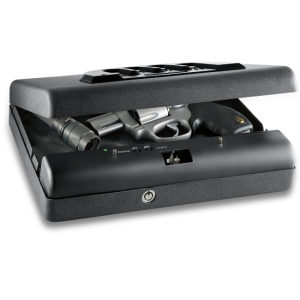
 The specifications for the GunVault MVB500 list it is ideal for home and travel with its fast entry, 15 finger print memory, and 20 gauge steel construction. It included a braided steel cable, 4xAA battery pack, and two spare keys. The retail price was just under $250.00.
 been very impressed ever since. In my opinion, it has functioned exactly as advertised. With a very easy-to-understand instruction manual, programming fingerprints into to the system was simple.
 In less than 10 minutes, I was able to program three fingers from both my wife’s and my hands into the system. We even tested the system to ensure that the biometric lock would reject unauthorized fingerprints, which it consistently did.
 the unit at an angle that would be easily accessible with both my wife’s and my right and left hands. The unit is large enough for me to secure a Sig P227 with an extended magazine inserted and light/laser attached to the rail. The original batteries have lasted for over three years now and I only replaced them to ensure that they would not fail when most needed.

