Showing posts with label Personal Defense. Show all posts

Thursday, June 18, 2015

Shotshells in Revolvers

Shotshells in Revolvers
In this article, I’ll answer a reader’s question regarding shooting Shotshells in Revolvers for personal defense. Specifically, I’ll discuss the difference between revolver shotshells meant for pest control and shotshells designed for personal defense.

“I’ve been reading the Ballistics Series and your articles on personal defense with great interest. Good stuff! Where I live, there are many other people living in my home and there are other homes very close to mine. So, I’m very concerned about using ammo that would either over-penetrate an attacker’s body or go through walls if I miss. I’ve got a Smith and Wesson 686 4″ revolver in .38/.357. I practice a lot with the lighter .38 special rounds, but keep the gun on my nightstand loaded with .357 magnum hollow-points. I’m worried that using that much power may endanger my neighbors. Many personal defense articles highlight the benefits of using a shotgun for personal defense. I don’t have a shotgun, but I’ve come across a shotshell designed for revolvers. I think that I can get the best of both worlds by loading my .357 magnum with these shotshells that will do the job without worrying about shooting through walls. I’d appreciate your thoughts on this.” – Anthony

Anthony, thank you for the question. You bring up a lot of good points worth highlighting here and I’m glad you’re going the extra mile by reading-up on personal defense and asking questions. In the following paragraphs, I’ll address the different aspects of this issue one topic at a time.

Personal Defense Solutions


First, you’ve highlighted an important issue… firearm/ammunition selection. There are many different opinions on this topic available through blog articles, books, and classes. However, there is no single “ideal” solution that will fit every individual and every situation. Every person has a different level of body strength, visual acuity, and training. Every person also has a different home layout, both inside and outside. And everyone lives in a different area with varying levels of criminal activity and concern.
Firearm Safety Training


In the most general terms, rifles are terrific stand-off weapons that can deliver powerful projectiles with a high degree of accuracy at a number of distances. This high power may be counterproductive in an enclosed environment. Handguns, on the other hand, are easy to operate and to conceal (throughout the house or on your person), but the shorter barrels produce less velocity and accuracy. Shotguns with a regular stock or pistol grip are a bit more unwieldy in an enclosed environment, but they offer significant power, a wider variety of projectiles or shot choices, and are easier to aim and achieve the accuracy required for the situation.

Ryan Finn – The Truth About Guns
Ryan Finn – The Truth About Guns.
http://www.thetruthaboutguns.com
In the photo to the right, you can see the results of a number of different results from ammunition that was fired through four layers of sheet rock. If you click the photo for a larger view, you can also see that only the #4 birdshot did not fully penetrate the 4 layers. Although the test does not describe how much energy each projectile maintained as it passed-through the fourth layer, it is clear that there was the potential for some degree of injury to an innocent bystander struck by a projectile that continued to travel through the walls. To read Mr. Finn’s article click here.

The bottom line is that there is an ideal firearm/ammunition solution available to meet the requirements of each individual to address threats in their environment. Since you own a .357 Magnum revolver, but are worried about over-penetration, you are making the right considerations for your individual situation.

Shotshells for the .357 Magnum


In this instance, you are both right and wrong. You are right in the fact that there are .357 Magnum cartridges that contain birdshot instead of a solid projectile. CCI/Blazer produces such a cartridge. It is the Blazer Shotshell #3738, which contains a total of 100 grains (about 150 pellets) of #9 birdshot in a small plastic capsule. CCI lists the muzzle velocity at 1,000 feet per second.

At first glance, it seems like shooting an assailant with this cartridge would create a nasty wound. Hell, 100 grains of shot traveling at 1,000 feet per second also sounds like it would produce the result desired. Quick math tells us that this produces 222 ft/lbs of energy… if it was a solid projectile! However, it is not a solid projectile, but a group of small projectiles that weigh about 0.67 grains each and would only produce any degree of damage if they remained clustered close together. Continue Reading »

About Author Howard Hall

Howard has served for more than 20 years in the Marine Corps. He has served as a Platoon Commander, Company Commander, Battalion Executive Officer, Regimental Operations Officer, and Battalion Commander. He has multiple combat tours to include serving as a military transition team member in Fallujah. He is an NRA Certified handgun instructor and holds numerous Marine Corps training credentials. An active competitor in action pistol (United States Practical Shooting Association), long range rifle (NRA F-Class), and shotgun (Amateur Trapshooting Association, National Skeet Shooting Association), howard has earned numerous accolades and medaled during DoD competitions with the 1911 platform in bulls-eye shooting.

Thursday, December 4, 2014

Terminal Ballistics – Part II

Terminal Ballistics
Welcome back to the second and final installment in the Terminal Ballistics series, which will also complete the Ballistics Series. In Terminal Ballistics I, we covered key terminology and highlighted the common goal of hunters, law enforcement, and home defenders… to incapacitate game animals or felonious assailants with as few shots as possible. We also covered the two methods that bring about incapacitation: a well aimed shot to the Central Nervous System (Medulla Oblongata or the upper spinal cord) and severe blood loss. In this article, we will cover projectile characteristics, best practices, and conclude the series.

Terminal Ballistics in Hunting and Personal Defense


With a wide variety of options in caliber, construction, and velocity, which combination is best? That is certainly a loaded question… pun fully intended. Short of providing overwhelming destructive force, which does not serve the hunter very well and is not typically an option for the home defender, the problem lies in having many options to address an even wider variety of possible conditions. Within these options lie a number of trade-offs. I’ll explain below.
As we’ve covered in the previous article, the most reliable method to take-down a game animal or end a felonious assault is to place an incapacitating shot into the central nervous system. In order to do this, a projectile of any caliber must possess sufficient velocity to penetrate the skin (animal or human), pass through layers of muscle and tendon, and destroy or at least interrupt the vital organs. Although it is often dismissed as an effective cartride, even a small .22 caliber long rifle projectile can accomplish this desired effect. However, as we’ve discussed at length, the central nervous system represents a disproportionately small area of the body in which this incapacitating shot can be taken. All other shots rely on severe blood loss, skeletal immobility, and shock.

All other things being equal (velocity, projectile construction, mass, etc.), penetration is essential to reach vital areas. This is where it can get confusing and the trade-offs take place. Since most projectiles are constructed with a combination of dense cores covered by softer metal jackets, small caliber projectiles will have a greater sectional density and thus require less velocity to penetrate. Robert Rinker equates this to comparing the force required to thrust both a small pin and a construction nail through remarkably pliable flesh. With greater sectional density and smaller diameter, the pin will require less force (momentum) to overcome the tensile resistance of the skin.

OK… so small calibers penetrate more easily. However, if it does not hit the small zone in which rapid incapacitation can occur, the small caliber projectile at high velocity can penetrate and pass through (often called over-penetration), leaving only a small permanent wound cavity which fosters only moderate blood loss. This can result in a lost game animal or an assailant who can continue the attack.

A projectile that expands on impact is beneficial since it creates a permanent wound cavity larger than the original caliber while maintaining the momentum of its original weight. However, rapid expansion hinders penetration.

So, both the hunter and home defender need to start with the terminal ballistic effect desired and work backward to develop a solution in terms of projectile construction, velocity, and firearm type. Hunters know their game type and relative distances from which they will be taking the shot. External Ballistics Part III introduced velocity measurements and how to calculate residual velocity at different ranges. Home defenders know that the majority of pistol shots will be taken at roughly 20-25 feet. My recent article on Handgun Velocity demonstrated the effects of barrel length and temperature on velocities.

Armed with this knowledge in mind, here are some of the differentiating characteristics of projectile construction. Read More >>

About Author - Howard Hall


Howard Hall "Range Master at Aegis Academy" - has served for nearly 20 years in the Marine Corps. He has served as a Platoon Commander, Company Commander, Battalion Executive Officer, Regimental Operations Officer, and Battalion Commander. He has multiple combat tours to include serving as a military transition team member in Fallujah. He is an NRA Certified handgun instructor and holds numerous Marine Corps training credentials. An active competitor in action pistol (United States Practical Shooting Association), long range rifle (NRA F-Class), and shotgun (Amateur Trapshooting Association, National Skeet Shooting Association), Howard has earned numerous accolades and medaled during DoD competitions with the 1911 platform in bulls-eye shooting.
Saturday, May 17, 2014

Carlsbad Wildfire, Personal Defense and Natural Disasters

Carlsbad Wildfire, Preparedness and Personal Defense


Carlsbad Wildfires - Personal-Defense and Disaster Preparedness
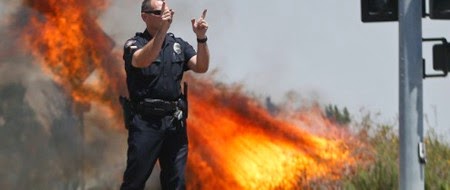
Natural disasters like the Carlsbad wildfires, and the rest of the fires in Southern California this week bring out the best in most normal people. The outpouring of support, donations at the emergency shelters, and offers of assistance is what make this country great! Conversely, it also provides opportunity for the criminal element to take advantage of people and the situation. As disgusting as the opportunists are, they do not surprise me. I am however continually surprised by the lack of preparedness for these predictable events on the part of many of my fellow citizens.

As soon as I smelled smoke, I went out side to see some fairly dark fires, that appeared to be pretty close. I went inside, picked up the keys and my wallet and drove to the gas station to top off the truck (which was at ¾ of tank, but why not have a full tank?). I grabbed a sandwich from the store for lunch, some fruit and a few other items and went home. When I got back there were a few people standing in the street looking at the plumes of smoke and discussing leaving.

Here is a conversation I had with a guy who lives in my neighborhood on the day the fires started:

Him – “The wildfires are getting pretty out of control, I didn’t expect this in Carlsbad.”

Me – “Yeah, I’m surprised at how quickly this one seems to be growing.”

Him – “Do you think there will be an problems, like looting or theft, or – you know – armed robberies or anything.”

Me – “Yeah, probably.”

Him – “Seriously, you think people will do that?”

Me – “Yes, if this goes on long enough, the dregs of society will take advantage of this situation and exploit the opportunity to prey on those who are not prepared.”

Him – “Yeah, probably… Well, I’m coming to your house if it gets bad.”
Me – “Why?”

Him – “You’re – like – ready for this stuff, you do – like – guns & stuff right?”

Me – “I am prepared to take care of my family.”

Him – “Well – you’d help us out too – right?”

Me – “Sure, how about you and the rest of the block, or maybe the neighborhood? How about the whole city? Look XXXX, I’m not Donald Trump and I had to draw the line when I was stocking up somewhere, and unfortunately, my family is the only ones that made the cut.”

Him –“Really, you wouldn’t let us in?”

Me – “XXXX – don’t show up at my house with your wife and kids in tow and your hand out at two o’clock in the morning – you won’t like the response. Go to the store, buy some canned food, fill up the tub, (etc….).

Him – “Well then, can I borrow a gun?”

Me – “Why?”

Him – “I don’t have one.”

Me – “Do you know how to use a gun?”

Him – “Well…. you could show me…”

Me – “No XXXX, you can’t borrow a gun…”

My suspicion is that XXXX thinks we aren’t friends anymore. I am not advocating that everyone have a 5 year stock pile of food, water, ammunition and spare parts for their firearms. I am advocating that people learn from this, and past experiences. Go get and learn to use the things and the skills you wish you had on Tuesday night. Don’t wait for the next disaster to make you feel helpless. None of you or your neighbors are helpless, and everyone is capable of contributing to their own safety and security!

My conversation with XXXX reminded me of another conversation I had with an individual on the plane to New York to speak at the CT symposium. I was reading the final edition of Preventative Defense written by Steve Tarani. He was a nice enough guy, little nervous about flying, perhaps a bit overly talkative, but a legitimately nice guy. When he asked what I do, I explained it briefly and he actually was pretty surprised and told me he felt no obligation to be prepared to defend himself what-so-ever. The most notable quote from that conversation “That’s what I have an attorney for”. I gave him the copy of Steve’s book as he clearly needs it more then I do.

The power outages last year produced a similar “what do I do” response in many people. Here we are almost a year later, and many still have no ability to plan or prepare for the inevitable. It would appear that we are on our way back to the norm in Carlsbad – at least for the time being. The fires have burned most of the available brush, and my suspicion is that we will have a relatively safe fire season in comparison to the areas that remain untouched by the fires. Now is the time to prepare yourself for the next disaster that may cause you to have to fend for yourself for a few days (or longer).

A week or so of canned goods, a trauma and first aid kit, a battery powered radio, a flashlight, extra batteries, a shotgun with plenty of buck shot, a few gallons of water in a go bag of some sort and a family link up plan will alleviate nearly every fear expressed by the people I spoke to this week. The problem is not one of means; all of my neighbors can afford the $500.00 – $600.00 to get the above items. The problem is one of mindset. The attitude that it will never happen to me is not something you can purchase a solution to. The concept that borrowing or buying a shotgun without the ability to use it effectively makes you somehow safer is equally ridiculous.

Every one of you can take five minutes to make to make a list that will help prepare you for a wildfire, a black out, an earthquake or any other natural disaster. Those of you that had some preparations made should take a few minutes to make some notes on what to improve on. It will take less then an hour to make a list, gather the things you need, and start the process of being a confident part of the solution during the next disaster. The alternative is to be a drain on state or others resources that could be deployed or used to support the emergency, or people who lost their homes, or others in dire circumstances…

Being an unnecessary drain on resources is actually considered quite rude in some circles.

Most of you reading this are probably already prepared, but feel free to share this with those who are not. We choose to be dependent on government services for our survival, our government does not impose that dependence on us – unlike some places in the world. Here in America, we can choose not to be dependent on government support and services when and if necessary. To me that is the responsible choice that leads to safer and more productive communities.

Here is a link to wildfire preparedness, with a short checklist and there are ton of resources out there. The checklist is a nice tool. What we really should be working towards is a culture of community safety and personal responsibility. Don’t let something as routine as the Carlsbad Wildfire or the next natural disaster throw you into a state of panic. Stay safe, have fun & plan to do something to increase you independence this month!

First Published at Aegis Academy

About Author


- Patrick Henry


President


Patrick Henry
Patrick Henry received his operational training and experience from the U. S. Government, 22 years of which were spent in the Marine Corps where he served in the Reconnaissance, Infantry and Intelligence fields. During his active service, he spent more then seven years deployed overseas in combat, operational and training assignments. After the military, Pat worked as a contractor and as the Director of Operations at a private paramilitary company, specializing in training special operations forces and providing protective services to select private clients. His education consists of an MBA from the University of Southern California (USC), and a BS from San Diego State University with an emphasis in Biochemistry, Cell and Molecular Biology and a minor in Psychology. He holds an extensive list of security and training related certifications from a variety of government and nationally recognized entities. He currently sits on the advisory committee at USC’s Master of Veterans Business Program, and is an active member of Infraguard and the American Society of Industrial Security (ASIS). He has been a guest speaker at ASIS, the San Diego Industrial Security Awareness Council and other private organizations on physical security, travel security, and competitive intelligence collection counter-measures.