
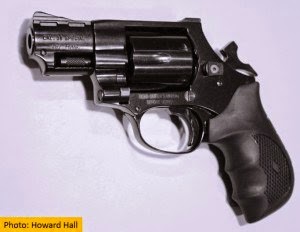
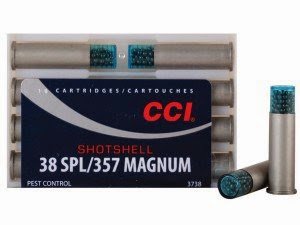
I discussed this topic with one of my friends who works at Cabela’s in Hamburg, PA and mentioned that I was in the market for a rugged snub-nosed .38 special/.357 magnum revolver that could fit my large hand. He showed me a wide variety of revolvers from Ruger, Smith and Wesson, and Taurus that ranged from $450.00 to $900.00. Since I was only going to incorporate this revolver into basic firearms instruction and the occasional camping trip or weekend at the cabin, I challenged my friend to find one that met my specifications at or below $300.00. After a few minutes, he presented me with the EAA (European American Arms) Windicator, which is a 2 inch snub-nose blued revolver in .38/.357… for under $300.00!
Although it was a small 2 inch snub-nose, this revolver felt solid and the generous grip filled my large hand quite well. A cursory inspection verified that the lock-up and timing were acceptable. Dry-firing verified that the double action trigger pull was long and heavy compared to the short and light single action pull. Everything checked-out at the counter, but I wanted to do a little more research before committing to the purchase.
Over lunch, I looked-up everything I could find on the EAA Windicator. European American Arms (EAA), based in Florida, has been importing this revolver from a German company named Weihrauch for quite some time. The reviews spanned the gamut from “phenomenal” to “worthless.” A few reviewers cited their revolver losing its timing after firing thousands of high pressure .357 rounds or claiming that it was insufficient for IDPA shooting. Many reviewers cited that it was a great bargain for the price.
Since my expectations and intended usage were more in line with the price point than those who expressed disappointment in their reviews, I purchased the revolver, a few boxes of American Eagle .38 Special ammo, and set out to test it and form my own opinions. With the help of my friend, Al Rice, we put the Windicator through its paces at Sharpshooters in Lorton, VA.
By the Numbers
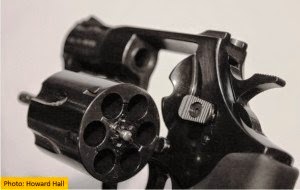
Fit
As mentioned above, the Windicator’s grip was substantial enough to fill my hand, but was not so prohibitively large that a shooter with a smaller hand couldn’t establish a sufficient and comfortable grip. This revolver pointed naturally and the “length of pull” (distance from the back-strap to the trigger face) was appropriate for me to place the pad of my index finger where it belonged for a smooth trigger pull. From a double action start, the length of pull measured 2.525 inches and the sear broke at 2.105 inches, which means that 10+ pounds of steady pressure had to be applied throughout the trigger’s 0.420 inch travel. Conversely, cocking the hammer for a single action shot reduced the length of pull to 2.170, which leaves the shooter to apply 4 pounds of pressure over a very short 0.065 inch to break the shot.
Function
Again, I chose this revolver as a training aid for basic firearms instruction and as a utility firearm while camping or at the cabin. As such, the 2 inch snub nose makes it ideal for the classroom and the field. Also, while many new revolver designs for concealed carry are double-action-only “hammerless” (where the internal hammer has no exposed spur), I needed a DA/SA revolver with exposed hammer and spur for instruction and to provide the option of a heavy and deliberate double action or planned and light single action shot. Read More »
About Author: Howard Hall (Range Master)
Howard has served for nearly 20 years in the Marine Corps. He has served as a Platoon Commander, Company Commander, Battalion Executive Officer, Regimental Operations Officer, and Battalion Commander. He has multiple combat tours to include serving as a military transition team member in Fallujah. He is an NRA Certified handgun instructor and holds numerous Marine Corps training credentials.
An active competitor in action pistol (United States Practical Shooting Association), long range rifle (NRA F-Class), and shotgun (Amateur Trapshooting Association, National Skeet Shooting Association), howard has earned numerous accolades and medaled during DoD competitions with the 1911 platform in bulls-eye shooting.

 Welcome back to our study of ballistics. Now that we’ve covered the many aspects of internal ballistics and how ammunition interacts with the inner

 Transitional Ballistics, Yaw, Precession and Nutation: Simply defined, Yaw is a deviation of a forward moving aerodynamic object from its longitudinal axis. Precession is an angular force applied to a rotating object caused by its torque. Nutation, literally “nodding,” is the opposing force in a rotating object that gradually “normalizes” along the longitudinal axis during projectile flight.
 Wow! So what does that all mean? During the
 OK… let’s try it again in plain English: There is a brief moment when a projectile leaves the barrel in which it is somewhat unstable. This instability is caused by a combination of the projectile’s rapid transition from controlled rotation to free rotation and the introduction of air resistance. During this period, the projectile “wobbles” in a helical pattern as it moves forward before it fully stabilizes. You can also see this in slow-motion replays of long football passes. When the football leaves the quarterback’s hand, it is rotating along its longitudinal axis, but is wobbling for a short distance before it stabilizes into and travels to the receiver (or not). The same is true for a projectile!
 How does this affect the average shooter? Pistol shooters should know that these principles exist, but have little to be concerned with. The short length of pistol projectiles allow them to stabilize quickly and within just a few feet. Rifle shooters, on the other hand, fire longer projectiles that require up to 48 feet to stabilize. Matching the projectile shape and weight to the propellant charge and barrel rifling will minimize (but not eliminate) the intrinsic instability of the projectile as it leaves the muzzle. This will allow it to stabilize more quickly and efficiently allowing it to travel with greater precision and energy conservation to the target.