Thank you for your continued interest in the study of ballistics. So far, we’ve covered the broad framework of
firearm ballistics followed by two in-depth discussions regarding internal ballistics (
firearm function and
mechanical precision). In this article, I will conclude our discussion on internal ballistics by focusing on ammunition characteristics and safety.
In contrast to firearm function, which focused on the mechanical interaction of individual firearm components, understanding ammunition requires a focus on the thermodynamic conversion of chemical potential energy into kinetic energy. At the center of this energy conversion is the important concept of pressure. Rapidly expanding gasses create the pressure required to expand the cartridge case against the inside of the chamber, propel the projectile forward, and cycle semi-automatic weapons.

Attaining consistent and safe pressure is the key to precision and reliable firearm function. Too little pressure causes firearm malfunctions and reduces both precision and terminal ballistic performance (bullet expansion, etc). Too much pressure can cause injury to the shooter and damage the firearm.
In addition to precision and function, three very important ammunition concepts relate directly to safety: the misfire, the hang-fire, and the squib-load. A
misfire occurs when the firing pin properly strikes the primer, but the propellant does not ignite. A
hang-fire occurs when there is a perceptible delay between the firing pin striking the primer and propellant ignition. A
squib-load occurs when the firing pin strikes the primer and the propellant ignites but produces insufficient pressure to expel the projectile from the bore. These will be explained in greater detail below.
In order to fully understand how energy conversion, gas expansion, and pressure interact to fire a projectile, let’s take a detailed look at ammunition components.
Ammunition Components
 Nomenclature:
 while often referred to by many different names (ammo, bullets, shells, etc.), ammunition is technically an enclosed system of components (case, primer, propellant, and projectile). For clarity, I will refer to the system of components as a cartridge.
Case: In general terms, the case holds all of the components together. Rifle and pistol cases can be made from brass (gold color), aluminum (gray), or steel/nickel (silver). Four main parts of a case are the primer pocket, rim, wall, and mouth. The open volume inside of the case determines the maximum amount of propellant the cartridge can hold.
 Function –
 as the propellant ignites and produces rapid gas expansion, pressure forces the case walls and mouth outward to form a tight seal against the inside of the chamber. Forming this tight seal is important for two reasons: (1) it directs remaining pressure forward to efficiently propel the projectile; and (2) it facilitates the rearward momentum required to cycle most semi-automatic firearms. Loss of pressure due to cracked or malformed cases can cause firearm malfunction or injury. What You Should Know – All shooters should routinely check a portion of their spent cases for signs of overpressure (cracks, bulges, elongation, etc.). Spent shell cases that show signs of overpressure indicate a possible firearm malfunction.
 Primer:
 The modern percussion primer consists of a small metal cup that contains a pellet of sensitive explosive material secured by a paper disk and a brass anvil. A strike from the firing pin on the center of the cap compresses the primer composition between the cap and the anvil. This causes the composition to ignite. Holes or vents in the anvil or closure cup allow the flame to pass through the flash hole in the cartridge case and ignite the propellant. Primers are constructed to be rugged enough to prevent unintentional detonation while retaining malleability to assure consistent ignition.
Function – the primer plays a major role in the ignition sequence. Conversely, it can either be the source of or the key to diagnosing firearm malfunction.
What You Should Know – (1) when firearms and cartridges are functioning properly, routine inspection of spent cases should indicate uniform firing pin indentations in the center of the primer. The same routine inspections can also identify excessive pressure (primer flow – the primer is literally either pushed out of the primer pocket or is spread along the base of the cartridge).

(2) in the event of a misfire (no primer ignition), inspect the primer to determine if the firing pin either struck the primer off-center (improper headspace or extractor tension), did not strike the primer with enough force, i.e. a “light strike” (could indicate a dirty firing pin channel, broken firing pin, or improper headspace), or the cartridge malfunctioned (primer set too deep in the pocket or the primer itself is bad). In the latter case, if the problem persists among multiple cartridges, attempt to fire a different brand of ammunition through the same firearm to determine if it is an ammunition malfunction or firearm malfunction. If it is the ammunition, sequester the remainder of the box, note the lot-number, and contact the manufacturer. (3) hang-fires and squib loads are not normally attributable to primers.
 Propellant:
 more commonly known as “gunpowder,” propellant has come a long way since its first use in firearms in the early 1200s. Most modern propellants are double-based nitrocellulose compounds produced in a variety of physical dimensions (densities and shapes). These densities and shapes determine how quickly the propellant burns.
Function: Three components are need for combustion: kindling temperature, combustible material, and oxygen. In conjunction with the primer’s flame, propellant contains all three. Through thermodynamic conversion, the mass of the propellant is changed into heat energy. During deflagration (rapid burn), heat energy is converted into massive gas expansion which creates the required pressure to complete the sequence.
What You Should Know – (1) in the event of a hang-fire, keep the weapon pointed in a safe direction for at least 30 seconds before opening the action to remove the cartridge. It is difficult to determine exactly what causes a hang-fire, but the most likely causes are propellants that have degraded due to age or exposure to moisture (water, gun oil, etc).

(2) in the event of a squib-load, you will most likely hear an audible “pop” but not feel the full recoil of weapon. In most cases, the cartridge was loaded with either insufficient or no propellant at all. Initial pressure may expel the projectile from the cartridge case but leave it lodged in the barrel. Therefore, if you detect a squib-load while firing… stop firing immediately! With a projectile lodged in the barrel, firing the next round would create a dangerous overpressure in the firearm that could cause serious injury and damage major components of the firearm.
Projectile: Projectile construction, shape, and weight are most applicable to discussions on external and terminal ballistics, which I’ll cover in the next two articles. For internal ballistics, however, projectile shape and weight contribute to both mechanical precision and “impulse” or felt recoil.
Function: Robert Rinker, in his book “Understanding Firearm Ballistics,” lists the following conclusions in regard to projectile characteristics and mechanical precision: (1) the longer the projectile in proportion to its diameter (caliber) the more barrel twist is needed to stabilize it; (2) A very long nose projectile is good for drag reduction and aerodynamic efficiency, but is harder to stabilize; (3) A longer and heavier projectile can be stabilized at the same rifle twist by increasing velocity; (4) A slower projectile requires a faster rifle twist to stabilize it. In regard to impulse or recoil, it is a basic physics principle that it takes a greater force to move a heavier projectile from zero velocity to initial velocity than it does a lighter projectile. Therefore, firing a heavier projectile will result in a greater impulse/recoil.

What You Should Know: In most metallic cartridges, the projectile is held in place within the mouth of the case simply by friction. This friction is created by applying a light crimp on the outer edge of the case mouth. In some instances, the act of feeding (stripping the cartridge from the magazine) and chambering (pushing the cartridge into the chamber) can cause “projectile set-back. Although rare, this is caused by the projectile tip contacting the feed ramp on its way into the chamber. For shooters who load and fire cartridges in the same action, this is less of a concern. For personal defense cartridges, however, the same cartridges can be chambered and unloaded numerous times before being fired, and thus the same projectile contacts the feed ramp on numerous occasions. In the event the projectile is literally “pushed into” the cartridge case, the volume within the case is reduced and the potential for overpressure is increased. In rare circumstances, this overpressure can cause injury to the shooter or damage to the firearm. If you chamber and unload your personal defense ammunition multiple times, please conduct a visual inspection to ensure that you are not “setting-back” the projectiles.
Putting it All Together
Undoubtedly, your intended use (target practice, competition, hunting, self-defense) will ultimately determine which cartridge you purchase. However, understanding cartridge characteristics and functions as they relate to internal ballistics and pressure can help you become a better and safer shooter.
Next month, we will cover external ballistics and the factors that affect a projectile’s flight to your intended target. Until then, stay safe and shoot straight!
First Published at
Aegis Academy
About Author
- Howard Hall
Range Master
Howard has served for nearly 20 years in the Marine Corps. He has served as a Platoon Commander, Company Commander, Battalion Executive Officer, Regimental Operations Officer, and Battalion Commander. He has multiple combat tours to include serving as a military transition team member in Fallujah. He is an NRA Certified handgun instructor and holds numerous Marine Corps training credentials. An active competitor in action pistol (United States Practical Shooting Association), long range rifle (NRA F-Class), and shotgun (Amateur Trapshooting Association, National Skeet Shooting Association), howard has earned numerous accolades and medaled during DoD competitions with the 1911 platform in bulls-eye shooting.


 Recently, when I conducted this routine, I noticed how the Sig P227 failed to feed the first cartridge into the chamber which jammed the gun out of battery. Whereas a “tap” to the rear of the slide would normally return to the gun into battery, chamber the cartridge, and lock the slide and barrel to the frame, this cartridge was firmly jammed against the barrel’s feed ramp. For a home defense firearm that must be 100% reliable, I found this to be discomforting.
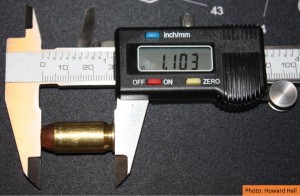 With a digital caliper, I measured the overall length (from the end of the cartridge rim to the leading edge of the projectile) of the ammunition from the box which had not been chambered into the Sig P227 and they measured 1.206 inches. This measurement was consistent with all other un-chambered cartridges.
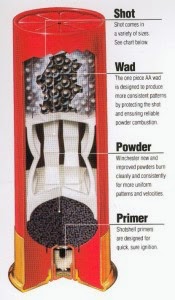
 This article answers a reader’s question and discusses shotgun ballistics.
 If you recall, our discussion on
  Whereas rifles and pistols are designated by the caliber of the projectiles they fire, shotguns are designated by the shotshell gauge. While most shooters have heard the common gauges of 12, 20, 28, and .410, few know the origin of the term. A shotgun’s gauge is determined by the number of round projectiles of equal diameter that can be subdivided from one pound of lead. For example, a 12-gauge barrel was designed around the fact that one pound of lead could be divided into twelve 0.727-inch lead balls. The same methodology is true from the 4 gauge down to the 28 gauge. .410 is the exception to the rule since it was simply a determination of the diameter of the bore in fractions of an inch.