Showing posts with label Training. Show all posts

Friday, September 18, 2015

Front Sight Focus

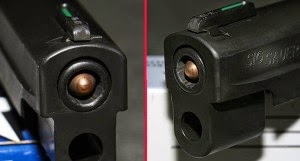
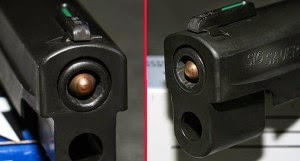
Front Sight Focus This article will answer a reader’s question debating the importance of front sight focus. While addressing this topic, I’ll also cover the mechanics of the human eye and the different types of pistol sights.

"A lot of instructors, including you, stress the absolute importance of sharply focusing on the front sight when shooting a pistol.  You also put a heavy emphasis on the importance of shooting tight groups in your articles and gun reviews. However, I attended some other courses and read a ton of other articles that downplay both the importance of front sight focus and shooting tight groups. In these cases, they emphasize gaining only 'flash front sight' to achieve ‘combat accuracy’ as the key to effective defensive shooting. I’m inclined to side with the latter because if I’m going to have to use my gun to defend myself, I’m not going to have the time for a sharp front sight focus and won’t need to maintain a tight group to stop the threat.  The only ‘score’ in a defensive shooting is defined by who is left standing.  So, why are you so insistent on establishing a sharp front sight focus and shooting tight groups?" - William in Poway, CA

William, thank you for the email and your question.  You bring up a good point regarding the different types of shooting which require varying degrees of front sight focus and accuracy. In general, bulls-eye and target shooting require a very high degree of focus and accuracy.  Conversely, rapidly reactions under extreme stress in a defensive scenario will typically allow for only the 'flash front sight' you mentioned.  However, regardless of the situation, you are morally and legally responsible for ensuring where every projectile lands.

Trigger control and aiming are the determinants of where your shots land. If you train to master these elements, you’ll not only build a solid foundation for gaining and maintaining true proficiency, you will be just as fast and considerably more accurate than those who aspire to only be good "combat shooters." Those who train to consistently accept a "flash front sight focus" are not enhancing their ability to shoot accurately, nor are they faster, and there is no practical benefit to training to a lower and less effective standard. Proficient shooters didn’t get fast by accepting sloppy sight alignment, they got fast by developing myelin along the appropriate neuromuscular pathways that resulted in consistently shooting fast and accurate groups over thousands and thousands of correct (perfect) repetitions. Combat accuracy is "good enough" in combat, but it should not be the standard by which you train.

To a certain degree you are right in stating that no one will be "scoring" your shots in a defensive scenario, but mastering the fundamentals and training to higher standards of proficiency will greatly increase your odds of being "the guy left standing" without injuring yourself or innocent bystanders.

In the following paragraphs, I’ll provide a more in-depth answer by covering the mechanics of the human eye in regard to front sight focus, different types of front sights, and conclude with considerations for training.

Aiming (sight alignment/sight picture)

By now, most of us have learned in basic pistol instruction that sight alignment is required to ensure the pistol is properly oriented to send the fired projectile in the desired direction. When combined with sight picture, the projectile consistently lands where it is intended.  While a minor error in sight picture may place the projectile in the wrong part of the target, a similar error in sight alignment may contribute to a missed shot.  Once proper sight alignment and sight picture are attained, effective trigger control ensures that neither the sight alignment nor the sight picture are interrupted when initiating the firing sequence.

Sounds easy, right?  Not so!  Too many shooters try to analyze and correct this myriad of variables simultaneously.  So, let’s break this down one element at a time.

The Mechanics of the Human Eye

Although the eye is an astounding sensory organ, it has a limited depth of field which allows for focusing on only one image at a time.
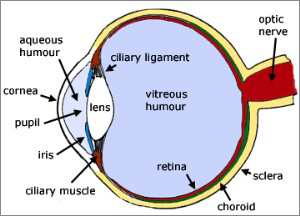
Front Sight Focus - Eye Diagram Light enters the pupil which acts as an aperture controlling the amount of light passing through two lenses which posit the focused image on the retina.  This image is then sent via the optic nerve to the brain.  The light passing through the eye is "focused" or sharpened by the two lenses. The outermost lens is the cornea, which is fixed, and the innermost is the crystalline lens, which is variable.   Altering focus from near to far objects requires a change in optical power which is controlled by the crystalline lens.  In order to focus on a distant object, the ciliary muscles relax and flatten the curvature of the crystalline lens.  Conversely, the ciliary muscles contract to create a bulge in the crystalline lens which causes greater refraction allowing focus on close objects.  Thus, it is impossible to focus simultaneously on near and far objects.  Establishing a sharp focus on one object renders all other objects in view in varying lesser-degrees of focus. Continue Reading »

Author: Howard Hall

Thursday, August 6, 2015

Bullet Set Back

ballistics
In his book, author, firearms instructor, and former Marine Paul G. Markel succinctly describes the journey through firearms proficiency from novice through “expert.” More importantly, he describes the attainment of "expert" not as indicative of the end of the journey, but a firm commitment to being a life-long student. Through my personal journey, I’ve had the opportunity to train, compete, and instruct in firearms disciplines… and there are still many things I learn every day. Although I’ve studied and written extensively on ballistics and considerations for personal and home defense ammunition, I recently "re-learned" a valuable lesson on bullet set-back that I’d like to briefly share with you.

For a number of years, I’d kept a 1911 in .45ACP as my home defense firearm and loaded it with 185 grain jacketed hollow-point cartridges. During this time, I’d followed the advice that I’ve often dispensed to “routinely train with the firearm, firing the personal defense ammunition to ensure 100% reliability and then thoroughly clean the firearm and the magazines."

Well, in the last two years, I switched my home defense firearm to a Sig P227 in .45ACP for the higher capacity (14 versus 8), the integral light rail, and the choice of Double Action or Single Action. Feeling confident with the 185 grain jacketed hollow-point cartridges, I kept the P227 loaded with this ammunition as well. At first, I routinely trained with this handgun/ammunition combination and found it to be as reliable as the 1911 that formerly held this role.

Another Step in the Journey


However, I "fell behind" on training with this system as often as I had in the past… opting to just unload the firearm and the magazines, clean and lubricate both, conduct a non-live-fire function check, re-load, and replace.

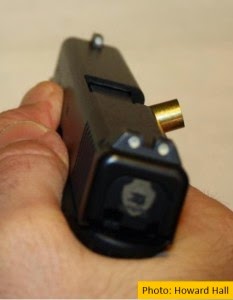
Sig P227Recently, when I conducted this routine, I noticed how the Sig P227 failed to feed the first cartridge into the chamber which jammed the gun out of battery. Whereas a “tap” to the rear of the slide would normally return to the gun into battery, chamber the cartridge, and lock the slide and barrel to the frame, this cartridge was firmly jammed against the barrel’s feed ramp. For a home defense firearm that must be 100% reliable, I found this to be discomforting.
When I unloaded the gun, the cartridge in question fell free from the magazine and I noticed that it looked “a little different.” Well, it looked a lot different… and so did the second cartridge in the magazine. THEY WERE SHORTER!!!! This different dimension, the overall length, is one of the contributing factors that led to the jam. Other than the obvious concern that these cartridges could potentially jam my firearm when I needed it the most, I wondered how many other cartridges in the magazine were "shorter?"

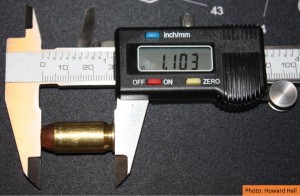
Digital CaliperWith a digital caliper, I measured the overall length (from the end of the cartridge rim to the leading edge of the projectile) of the ammunition from the box which had not been chambered into the Sig P227 and they measured 1.206 inches. This measurement was consistent with all other un-chambered cartridges.


The measurement on the “short” cartridge was 1.103 inches! Although this is only about one-tenth of an inch, it was enough to jam the gun. So, I did a quick test with a “good” cartridge and chambered it repeatedly while taking a measurement between each iteration. I had found that each time I chambered the same cartridge, the bullet “set-back” about five thousands of an inch (0.005?). This could be caused by an insufficient crimp (pressure from the inside of the cartridge case against the outside of the projectile), the edge of the blunt-tipped jacketed hollow-point impacting the feed ramp, or both.

The bullet set-back was not only altering the external geometry of the cartridge as it fed from the magazine into the chamber which increased the potential for a jam, it was also changing the dimensions within the cartridge itself.

Internal Ballistics, Pressure, and Bullet Set-Back


If you recall from the Ballistics Series, there are four components to a metallic cartridge: the case, the primer, the propellant, and the projectile. Ideally, the composition/density of the propellant fills the otherwise empty volume of the cartridge case for a uniform ignition. Continue Reading »

Author: Howard Hall

Thursday, March 19, 2015

Obtaining a Concealed Carry Weapon Permit in Orange County

I decided to write this article to try and provide some insight into the Conceal Carry Weapon (CCW) permit process. This article is Part 1 on a series of articles I will be writing related to CCW. Please check back with us so you can read the complete series.

Ca Gun Control Patrick Henry Gun laws
I have come across many people who have not even tried to obtain a California CCW out of fear of being denied. Fortunately and possibly due in part to some recent court decisions, obtaining a CCW firearms permit has become much easier.

For the most part, the process will look very similar no matter where in California you might live. Being that I am an Orange County approved CCW instructor, I will write about obtaining a concealed carry weapon permit in Orange County.

Orange County CCW Process

You will first want to contact the sheriff’s department in the county you reside in. Most city police agencies have an understanding with the sheriff's department that they will defer CCW applicants to the sheriff’s department for processing.

Once you are in contact with a sheriff’s department representative, request an initial interview. Depending on your jurisdiction, you may be able to do this through the department’s website. Essentially, you provide your name and email and within a few days you should receive a response to your email, which will include your appointment date, time and location. Now, don't let the email scare you. It will probably tell you that your appointment date is six to twelve months away, but you have to start the process sometime!

Orange County
Fortunately, there is good news. What typically happens as your interview date draws nearer is you receive an additional email telling you that an earlier date is available, and asking you if you want that appointment instead. This can shorten your wait time by months at a time. Be sure to keep track of the initial email despite anticipating a second email: the initial email will also have an attached CCW application and checklist.

Preparing for the interview

Be prepared! Make sure you have brought in everything that was requested by the sheriff’s department including a completed application, proof of residency, a driver’s license or some form of government identification such as a passport, a birth certificate, and a recently taken passport quality photo. There will be a checklist; be sure you have brought in all the items on the list in order to expedite the process. You may want to consider dressing professionally, it can only help you.

Gun-Workplace
Meeting with the investigator for your interview may sound intimidating, but in most cases it is a very easy, relaxed process. The investigator will go over your completed application with you. Depending upon your background he or she may ask you to clarify a few things. Be truthful about everything. At the conclusion of the interview, which will take probably less than 20 minutes, the investigator will have you sign your application in their presence under penalty of perjury. Remember what I said about being truthful!

In all my dealings with these law enforcement professionals I have always found them to be very easy to deal with. I am sure you will leave there feeling like that was a lot easier than you thought it would be.

Residency Check:

In Orange County you can expect that a uniformed deputy will be knocking on your door within the first week of submitting your application. The sheriff’s department must verify that you live in the county and at the address you provided. If you are not home they will knock on your neighbors’ doors to see if anyone can verify that you live at the address you provided. The deputies will not discuss with the neighbors the reason for the request, so it may leave your neighbors a little curious.

policework
Once the residency check is completed and verified you move to the next step, which is rather informal. An initial background check will be done on you and your file is sent up the chain of command for initial approval. A supervisor will look over your file to make sure nothing is missing. If there is nothing out of the ordinary you will move forward to the next step.

Initial Approval:

About 4-6 weeks after your initial interview you may receive an initial approval email. The email will state that you have been initially approved to move forward in the process. The email will include instructions on completing your live scan and on completing your CCW training course. Be sure to complete the live scan as soon as possible because it can take 4-8 weeks for your background to be conducted and cleared. Next, select an instructor (look for an upcoming article on how to select an instructor) from the approved list, complete your initial CCW training course, and obtain your certificate.  Send a copy of your course certificate to the sheriff’s department CCW unit either through email or fax.

Final Approval:

Once you have completed all of the above there is nothing more to do except wait for your background to be completed. If you are approved by the department you will receive a final approval email. The email will have a date for you to return to the sheriff’s department to sign the terms and conditions and pick up your new permit.

In Closing:

Training and education
Carrying a concealed firearm is a big responsibility. Negligent discharges are important reminders of how serious this responsibility should be taken. Negligent discharges can occur for a variety of reasons, but it is usually the fault of the person holding the gun. Many people who first obtain their CCW become over confident in their skill set. Just because you have been approved to carry a loaded gun doesn’t mean you have developed the necessary skills to do so! Most of the negligent discharges that I have witnessed occurred when the shooter was either drawing or holstering their firearm. It is in your responsibility to practice on a regular basis. I would suggest you continue your training and education by enrolling in further firearms training to supplement your CCW course. Lastly, always store your firearm in a lawful manner; and always adhere to the terms and conditions of your permit.

I hope you have found this article helpful. If you have questions feel free to contact me directly via email.

Author: Jason Granados (Firearms Instructor)

Jason Granados is a law enforcement veteran with more than 10 years experience. His duties and responsibilities were as follows. He spent more than five years assigned to the departments special tactics unit. During his time in this unit he was a supervisor in the unit as well as the team leader. He also served as the departments firearms instructor where he taught pistol, shotgun and carbine. During this time he was responsible for maintaining the departments qualification standards. Jason has also testified in State Superior Court as a firearms expert. Jason also has more than 10 years experience in martial arts and is a black belt in Brazilian Jiu Jitsu. Jason continues to compete in Martial Arts competitions and is currently ranked #5 in the world by the International Brazilian Jiu Jitsu Federation.

Source: http://aegisacademy.com/community/obtaining-a-concealed-carry-weapon-permit-in-orange-county/

Tuesday, March 10, 2015

Diagnosing Pistol Malfunctions – Part 3: Failure to Eject

Stove-Pipe-IIWelcome back and thank you for returning to read the final installment in the Diagnosing Pistol Malfunctions series. To cover the wide range of topics in this series, I have broken the 8 elements of the cycle of operation into the three commonly accepted types of pistol malfunction. Part 1, Failure to Feed, covered the first three elements: feeding, chambering, and locking. Part 2, Failure to Fire, covered the fourth and fifth elements: firing and unlocking. In Part 3, Failure to Eject, we will discuss the remaining three elements within the cycle of operation: extracting, ejecting, and cocking. Within this category of stoppages, I will analyze the three main causes: (1) failure to extract; (2) double feed; and (3) stove pipe.
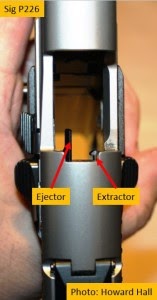
As we begin this discussion, I believe it is important to once again emphasize the preeminent role of the extractor and highlight its counterpoise with the ejector. In both Part 1 and Part 2 of the series, I described the extractor’s role in properly guiding a cartridge case along the breech face during the feeding cycle as well as its role in firmly holding the cartridge in place centering the primer in front of the firing pin hole.

Extractor and EjectorIn Part 3, we will discuss the extractor’s profound role as the extractor claw “grips” the cartridge rim as the firearm unlocks and the rearward movement of the slide “extracts” the spent cartridge case from the chamber. As the slide continues its full rearward movement, the extractor maintains proper tension on the cartridge case holding it in position against the breech face until the continued rearward motion thrusts the base of the cartridge case against the ejector. Working in unison, the extractor continues to pull as the ejector pushes the spent cartridge case through the ejection port and away from the pistol… just in time for the slide to begin its forward motion which will feed the next round.
Failure to Extract

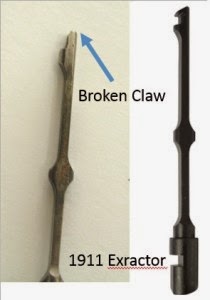
A failure to extract occurs when the cycle of operation is interrupted by a cartridge case that becomes stuck in the chamber. Even with a dirty chamber or a corroded cartridge case, the extractor tension combined with rapid slide movement create enough force to pull the case from the chamber. Therefore, the most likely cause of a failure to extract is either a broken extractor or one with improper tension.

Compares two 1911 extractors A brief visual inspection of the extractor claw can indicate excessive wear, damage, or a clean break. The photo to the right compares two 1911 extractors. One clearly has a broken claw. The only remedy to this problem is a full replacement. The good news is that most manufacturers produce quality extractors that are very affordable. They can range from $15.00 to $45.00 depending on the "name brand" you go with. Wilson Combat 1911 extractors are in the mid-$30.00 range and Glock extractors are just under $20.00. Since these are such an important item, it is a good idea to keep a spare extractor or two in your range bag.
When designed internal to the slide, such as most 1911s, the extractor is typically a solid piece of steel with a claw protruding into the breech. A "bow" in this solid piece of steel provides tension to the cartridge case. As such, the internal extractor itself can be considered a spring. The degree of the "bow" determines how much or how little tension is applied to the cartridge case.

When designed external to the slide, such as Glocks and Sigs, the extractor is one or more pieces of metal also with a claw protruding into the breech. External extractors rely on leverage and a spring to provide proper tension.
Whether internal or external, too much extractor tension may cause a failure to feed, but too little extractor tension could cause both a failure to feed and a failure to extract. In the case of a failure to extract, there just isn’t enough tension at the extractor claw to pull the case from the chamber. A visual inspection may not allow you to ascertain proper extractor tension.

If you recall from previous discussions, proper extractor tension can be determined by removing the slide from your pistol and pushing a loaded cartridge case against the breech face with the case rim under the extractor claw. Once in place, shake the slide in your hand. The cartridge should remain in place. If it falls free, there may be insufficient extractor tension.

If you determine you have insufficient extractor tension, I recommend conducting a detailed disassembly and cleaning of your slide. Built-up dirt may be limiting the movement of your extractor and its parts. If cleaning the extractor, channel, and springs does not correct the problem, then you may need to modify or change some parts. If you have a one-piece internal extractor, you can "bend" it a little further inward to
increase the "bow," and thus the tension. If you have an external extractor, you may need to replace the springs.

Double Feed

A double feed is one of the most difficult stoppages to clear… especially under pressure. "Tap… Rack… Assess" will either fail to correct the problem or create yet another double feed. It requires you to lock the slide to the rear, remove the magazine, “rack” the slide repeatedly to remove any cartridges, reinsert the magazine, and then chamber another round.

But what causes it? Read More »

About Author: Howard Hall (Range Master)

Howard has served for nearly 20 years in the Marine Corps. He has served as a Platoon Commander, Company Commander, Battalion Executive Officer, Regimental Operations Officer, and Battalion Commander. He has multiple combat tours to include serving as a military transition team member in Fallujah. He is an NRA Certified handgun instructor and holds numerous Marine Corps training credentials.

An active competitor in action pistol (United States Practical Shooting Association), long range rifle (NRA F-Class), and shotgun (Amateur Trapshooting Association, National Skeet Shooting Association), howard has earned numerous accolades and medaled during DoD competitions with the 1911 platform in bulls-eye shooting.

Monday, February 23, 2015

Diagnosing Pistol Malfunctions – Part 2: Failure to Fire


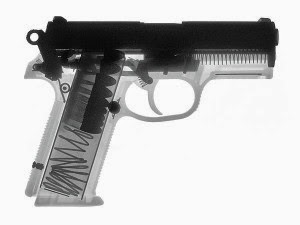
Hand gun x-ray print ray gun
Welcome back to our discussion on Diagnosing Pistol Malfunctions. In Part 2, we will cover an in-depth analysis of Failure to Fire.

Unfortunately, most of us have experienced this at one time or another. We’ve inserted a loaded magazine, released the slide, chambered a round, disengaged the safety, aligned the sights in the center of the target, slowly exhaled while pressing the trigger, and as we felt the sear release the hammer or striker we heard a “Click” instead of a “BANG!”

On the range, it may be an annoying inconvenience to wait 30 seconds with the pistol pointed in a safe direction before “tapping” the base of the magazine, “racking” the slide to eject a possibly bad round and chamber what we hope to be a “good” one, “assessing” the target area, and deciding whether or not to fire again. In a personal defense, law enforcement, or military scenario, however, the most deafening sound has been described as the “Click” instead of the “BANG” required to stop the threat.

In the previous article, we covered malfunctions that occur during the first three steps in the cycle of operation: Feeding, Chambering, and Locking. In this article, we will focus solely on malfunctions that occur in the “Firing” stage.

Assuming the pistol has successfully fed, chambered, and locked, there are only two types of malfunctions that would prevent the pistol from successfully firing. These can be isolated to either the ammunition or the pistol’s ignition system. First, let’s cover ammunition failures.

Ammunition Failure

If you recall from Internal Ballistics – Part III, we described pistol cartridge components: primer, case, propellant, and projectile. In order to focus this part of the discussion to ammunition, we need to assume that the pistol is mechanically functioning as intended and the cartridge is correctly chambered. Under these conditions, the ammunition failure must lie in the propellant or the primer.


SquibPropellant – If there is an insufficient quantity of propellant in the cartridge case, the primer/propellant ignition chain will not produce enough pressure to propel the projectile all of the way through the barrel. This is known as a “squib,” and the shooter should notice an audible “pop” instead of a “BANG” along with an under-powered recoil.
Propellant in the cartridge
Regardless, this is a failure in a number of ways. First, the projectile will not impact the target. Second, if the shooter does not correctly perceive the squib and errantly attempts to fire again with a projectile lodged in the barrel, the overpressure caused by the next round will damage the pistol and potentially injure the shooter. If you detect the audible “pop,” stop firing immediately.


Primer
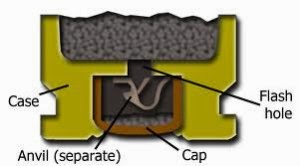
Primer – To briefly recap, the primer consists of a small metal cup that contains a pellet of sensitive explosive material secured by a paper disk and a brass anvil. A strike from the firing pin on the center of the cap compresses the primer composition between the cap and the anvil which causes the composition to ignite. Holes or vents in the anvil or closure cup allow the flame to pass through the flash hole in the cartridge case and ignite the propellant. The primer needs to be “tough” enough to withstand some jostling and extreme temperatures without igniting, but be malleable enough to fire when needed.

Again, in this section we’ve assumed that the cartridge is properly aligned on the breech face and the firing pin or striker has moved forward with enough force to ignite a normally functioning primer. However, there are some instances where the primer won’t function. First, the primer’s cap can be too thick or internal components can be incorrectly manufactured. Next, the primer can be set too low into the cartridge case and “out of range” of a normally functioning firing pin or striker. CartridgeLastly, an error in the cartridge manufacturing process can misalign, damage, or invert the primer. While all of the former defects would be difficult to ascertain, the latter can be diagnosed by visual inspection. (right inset photo)
Firearm Mechanical Failure


Turning things around, in this section we will assume that we have chambered a properly constructed cartridge, but a mechanical failure in the firearm itself is the cause of the malfunction. This leaves us to consider the following possibilities: (1) Something is preventing the firing pin or striker from moving forward with enough force to properly ignite the primer; (2) the firing pin is damaged; or (3) the firing pin or striker is moving forward properly, but the cartridge is misaligned Read More>>

About Author

Howard has served for nearly 20 years in the Marine Corps. He has served as a Platoon Commander, Company Commander, Battalion Executive Officer, Regimental Operations Officer, and Battalion Commander. He has multiple combat tours to include serving as a military transition team member in Fallujah. He is an NRA Certified handgun instructor and holds numerous Marine Corps training credentials.

An active competitor in action pistol (United States Practical Shooting Association), long range rifle (NRA F-Class), and shotgun (Amateur Trapshooting Association, National Skeet Shooting Association), howard has earned numerous accolades and medaled during DoD competitions with the 1911 platform in bulls-eye shooting.

Sunday, February 15, 2015

Pistol Magazines

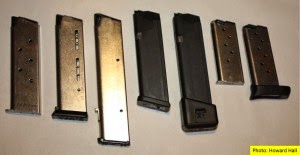
Magazine Lineup
This article focuses on one of the pistol’s most overlooked functional components… pistol magazines. In this article, I will cover a brief history of the magazine followed by a detailed description of magazine components and conclude with tips for magazine maintenance.

So why dedicate an entire article to pistol magazines? Well, two decades of competition shooting and on deployments around the globe have convinced me that the magazine is the leading cause of mechanical malfunctions in semi-automatic pistols (and rifles). Sure, there are other components like the extractor and ejector that vie for the top prize, but most would agree that the detachable box magazine is the clear winner. Furthermore, as a recreational shooter and firearms instructor, I've observed many gun owners reveling in their ability to clean and maintain their firearms while neglecting the magazines. If you are not yet convinced, here are two more reasons: (1) magazine maintenance is simple; and (2) a little effort can prevent a $40.00 part from turning a $1,000 pistol into a frustrating single-shot nightmare.

History


Borchardt_C93_with_magazine
The maturation of smokeless gunpowder through the latter half of the 1800's led designers such as Hiram Maxim to harness the recoil produced from firing self-contained cartridges to "auto load" the next round in his machine guns. Shortly thereafter, other firearm manufacturers sought to adopt this recoil-operated self-loading principle to pistols. In 1893, Hugo Borchardt designed the the C-93 (right inset) with an 8-round detachable box magazine, which became the first semi-auto pistol as we know it today.

Browning M-1900
Although Borchardt’s design was reliable, it was too large and unbalanced for mass acceptance. It didn’t take long, however, for other manufacturers to tweak and improve on the C-93, which led to the Mauser C-96 "Broom Handle," the German Luger Pistol, the Browning M-1900 (left inset), and… wait for it… the 1911.


1911_Navy_109967i
There have been plenty of innovations in semi-automatic pistol design and manufacturing over the course of time. The same can not be said, however, regarding innovations in semi-automatic pistol magazine design, which have changed little over the years.

Let’s take a closer look at pistol magazines.


Nomenclature

Although some of the materials have changed, most pistol magazines are comprised of the same components they have been for over 100 years.

Magazine Part
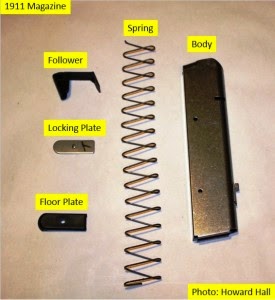
Body/Tube - a metal or polymer shell in which the components reside and interact to both store and feed cartridges as part of the cycle of operations. The feed lips, located at the top of the magazine tube, hold the cartridges within the magazine and work with the follower to ensure proper alignment for feeding.

Spring - provides constant tension to the follower which holds the cartridges in position secure against the magazine feed lips and ready to be fed into the chamber.

Follower - metal or polymer fitting that: (1) captures the top end of the spring; (2) uses spring tension to hold the cartridges in position secure against the magazine feed lips; and (3) contacts the slide lock after the last round is fired. Metal followers are more rigid than polymer followers, but polymer followers contain a greater degree of inherent lubricity which enhances their ability to glide within the magazine tube.

Locking Plate and Floor Plate - function together to capture the spring from within the bottom of the magazine. Read More »

About Author

Howard has served for nearly 20 years in the Marine Corps. He has served as a Platoon Commander, Company Commander, Battalion Executive Officer, Regimental Operations Officer, and Battalion Commander. He has multiple combat tours to include serving as a military transition team member in Fallujah. He is an NRA Certified handgun instructor and holds numerous Marine Corps training credentials.

An active competitor in action pistol (United States Practical Shooting Association), long range rifle (NRA F-Class), and shotgun (Amateur Trapshooting Association, National Skeet Shooting Association), howard has earned numerous accolades and medaled during DoD competitions with the 1911 platform in bulls-eye shooting.

Thursday, February 12, 2015

Give the gift of Firearm safety Course this Valentines Day

Valentines Day is around the corner, if you have not yet purchased your gift, here is one unique gift idea your loved one may appreciate slightly more.

Forget about roses, give her the gift of self protection this Valentines Day. Your Valentine — whether she’s your wife, girlfriend, daughter or sister — deserves something very special. Being able to handle the bad situation where anyone try to harm or stop anyone forcefully entering the house is must when you are on any business trip or elsewhere. What could be more sentimental than a tool she can use to defend herself?

Aegis Academy Gift Certificate for Valentines Day

Purchase a gift card of “Firearm Safety and Familiarization Course” at Aegis Academy in San Diego. This is entry level course, designed for inexperienced shooters, the course will cover general firearm safety and range safety procedures and basic weapons handling course for variety of pistol, shotgun and carbine. Including lecture and all necessary access to our online library.

And the best part is you will get California Handgun Safety Certificate, a must have thing to own a gun in California.

The course is scheduled on February 15, 2015 12pm to 5:30pm – perfect timing. Let that special person in your life know how much you care about them and their well being.

After the range, go out to dinner together and talk about her shooting experience and of course, stay safe !!

Tuesday, December 2, 2014

Terminal Ballistics – Part I

Understanding Bullet Impacts

Terminal Ballistics
Terminal Ballistics - Part I is the first in a two-part series which will begin to conclude the Ballistics Series by introducing the principles within Terminal Ballistics and focus on the various aspects of projectile impacts on target and their immediate effects. Leveraging the key concepts of projectile flight and construction, momentum and kinetic energy introduced earlier in the ballistics series, this article will illuminate some scientific facts in regard to the terminal effect of firearm employment for hunting, law enforcement and personal defense while also debunking some commonly-held myths. In researching this topic, I've relied heavily on authoritative sources such as Robert Rinker's "Understanding Firearm Ballistics, 6th edition," and the Federal Bureau of Investigation's 1989 report titled "Handgun Wounding Factors and Effectiveness."

Overview

Whether for recreation, competition, training, hunting or personal defense, this ballistic series has focused on the myriad of aspects that affect a projectile's flight to target in order to provide a better understanding and help you choose the right firearm/ammunition combination to safely and consistently place your shots on target and achieve the desired ballistic effects. From the mechanical interactions internal to the firearm to the atmospheric and physical conditions that affect projectile flight, this series has provided information necessary to harness mechanical precision into shooter accuracy. Now, we will discuss projectile impacts on target.

Since recreational and competitive shooters are primarily focused on measuring the effectiveness of their skill and technique by scoring shots on paper, cardboard, or interactive targets, terminal ballistics is simply a factor of hitting the target for score. For hunters, military/law enforcement, and personal defenders, on the other hand, the projectile's ultimate effect is eminently important since it is the sole reason for weapon employment. Although the conditions for weapon employment are much different in these latter cases, the desired result is the same… rapid incapacitation with as few shots fired as possible!

This rapid incapacitation is a factor of shot placement combined with velocity, kinetic energy, projectile weight, projectile shape and construction, caliber, and range to target as well as the nature of the target itself. In order to move forward with the discussion, we need to first discuss some terms and concepts common to both hunting and personal defense.

Terms and Concepts

  • Caliber - diameter of a projectile
  • Mass - in the most general terms, this is the weight of the projectile
  • Velocity - this is the instantaneous speed at which the projectile is moving. Projectiles exit the firearm bore with an initial velocity which immediately begins to slow down due to air resistance and drag.
  • Ballistic Coefficient - based on the shape and construction of the projectile, this number describes how well the projectile travels through the air and preserves its velocity. Read More »

About Author


Howard Hall - Range Master


Howard has served for nearly 20 years in the Marine Corps. He has served as a Platoon Commander, Company Commander, Battalion Executive Officer, Regimental Operations Officer, and Battalion Commander. He has multiple combat tours to include serving as a military transition team member in Fallujah. He is an NRA Certified handgun instructor and holds numerous Marine Corps training credentials. An active competitor in action pistol (United States Practical Shooting Association), long range rifle (NRA F-Class), and shotgun (Amateur Trapshooting Association, National Skeet Shooting Association), howard has earned numerous accolades and medaled during DoD competitions with the 1911 platform in bulls-eye shooting.

Thursday, August 28, 2014

Should a nine-year-old girl shoot an Uzi?

A nine-year-old girl shot the instructor in Arizona at a shooting range
I’ve had a number of phone calls and emails about this tragic incident asking questions about what happened, should it have been prevented and the like.  First off I have no access to any information that has not been reported by the media. I have nothing but a lifetime of experience teaching firearms skills, on which to base the following opinions.

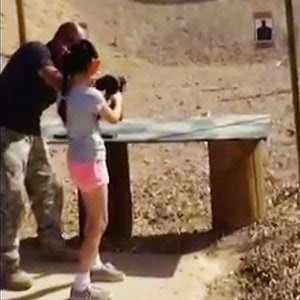
This week at a shooting range in Arizona, a nine-year-old girl shot the instructor she was working with in the head with an Uzi sub machine gun. This has sparked debate on gun culture, how old is old enough to shoot, at what point is a submachine gun to be introduced, range procedures and a litany of other issues. From what we know so far, there is some room for improvement. Here are the general questions people seem to be interested it.

Should a nine-year-old shoot an Uzi?


First off the Mac 10/11(AKA Uzi) has very limited application in the tactical realm. Other than for entertainment or very close range ambushes, they are generally useless. The blow back system creates substantially more muzzle climb then other sub-guns making them very difficult to control. There are far more controllable sub-guns out there (like the MP5) which would be a more suitable starting point as an introduction to sub-guns. For someone with limited or no experience, that is one of the last guns I would choose.

That said, there are seven year olds out there with the firearms experience, maturity and physical strength to control an Uzi. Age is largely irrelevant in shooting, and experience, strength and maturity are much better gauges to measure what any person can handle.  We flock to age because it’s easy to quantify, but it is a really crappy indicator. So can a nine-year-old-girl handle an Uzi safely… Maybe. Certainly yes in some cases, but generally probably not the best choice of firearm for a nine-year-old girl with little experience. Read Teaching Children to Shoot for more ideas on how to safely and effectively introduce children to firearms.

Were the Range Procedures adequate?


In reading the comments of the owner, there are a few things that indicate to me there are some gaps. First the instructor went from single shot to full auto on a fully loaded magazine. A far safer procedure would be to load a magazine with 2, 3, 4, and 5 rounds to give the shooter a bit of experience controlling muzzle climb in a progressive manner. Next would be to give the shooter experience stopping firing when muzzle climb causes the gun to come off target. Give them a few 5 round magazines and have them attempt to stop at 2 – 3 rounds (the appropriate method of employment) on their own. At that point a full magazine can be safely introduced.  Clearly that procedure (and there many other safe ways to do it), does not exist at the range as the owner indicated “all policies and procedures were followed”.

Was the instructor qualified?


The range owner stated that Charlie Vacca (the instructor who was killed) was qualified because “he had served in combat in Iraq and Afghanistan”, was in the Army and a member of the reserves. This indicates to me that the range owner does not really know what it means to be a qualified instructor. Additionally, it appears they have no good process in place to screen and train the people they hire.  The reality is that most military and law enforcement personnel are not qualified instructors. You learn to be an instructor by first becoming proficient, then by coaching under the supervision of other more experienced instructors, and finally by teaching on your own. Most of us continue to take courses from other instructors just to stay on top things. Range time and experience matter more than a NRA stamped piece of paper, but that piece of paper is better than nothing. According to the NRA, he was not an NRA instructor.

Teaching Experience Matters!


If you spend time on a range, you will see people do dangerous things. As you start teaching you start to key in on the precursors to people doing dangerous things. Initially you can react to minimize the danger. After a while, you can see it coming and head it off before it happens. When you can do that with out really thinking about it,  you are ready to teach independently.  I can’t tell you when that time occurs for an instructor. What I can tell you is that it is not hard to identify the instructors who have the experience to do so, from those who do not. I don’t like to to speak ill of the dead, but in this case, from the video I watched, this looks entirely predictable.

Could that happen here at Aegis Academy?


First, we don’t do half hour fun shoots, because although shooting can be a great time, in order for it to be fun and safe, you need more information than we can impart in 30 minutes. Our shortest class is a little over four hours. There are ways to do shorter introductions to firearms safely… But the less the shooter knows, the greater the risk.

Second, all of the staff at Aegis Academy has a minimum of ten years of Law Enforcement or Military service in Special Operations or SWAT units where range time was extensive. They have to have at least two years of instructor time with a department or agency before they can even be considered for employment. Lastly, everyone who works here must complete the instructor development program, which is an additional 5 days run by the Staff. Admittedly that certainly exceeds the minimum requirements to be a safe firearms instructor, but that is the minimum for our team.

Third, we have detailed written range procedures for each and every drill we have clients shoot. The range masters have the latitude to modify those drills to overcome individual training limitations as necessary. The process of writing up the procedures and drills, placing them into a binder and teaching the staff how to teach the drills in the instructor course is what makes the procedures effective. Writing it down doesn’t make you safe, but it’s a good place to start. It’s in teaching how and why the procedures apply that creates a safe environment.

So could it happen here? Despite all of the above – Yes, a client could shoot an instructor in the head at Aegis Academy. Saying anything else would be arrogant. We reduce that risk to as close to zero as we can, but when you’re dealing with a firearm, your risk is never zero.

An Instructor is dead, a girl’s life is forever changed


My sympathy goes out to the family of Charlie Vacca. My sympathy goes out to the girl who will undoubtedly suffer from the trauma she is experiencing over this event. Lastly, my sympathy goes out to her parents who will second guess this decision for the rest of their lives. Let us not forget, in pointing fingers and laying blame, that this was a tragic event that happened to what are probably very well meaning people. I never want to see anyone needlessly injured or killed, nor suffer the impact of doing so – with out good reason.

In closing, there are safe, effective and entertaining ways to learn to use firearms. This was not an example of that. The staff is internally reviewing the event as a group to see if there are some lessons we can take away. We prefer to learn from the mistakes of others. Whether you train here or elsewhere, asking what happened and how your instructor feels about it is both a fair question, and will give you some insight in how that person or company thinks and acts. Trust your gut and don’t be afraid to walk away if you don’t feel safe!

Have fun, but stay safe!

About Author


Chris White - Range Master


Chris White - Range Master
Chris White is 20-year veteran of the United States Navy (SEAL Teams) where he retired as a Chief (SO7). He has multiple combat tours and was assigned to three different SEAL teams as well as Naval Special Warfare Development Group during his active duty service. His key billets include: Assault Team leader, Platoon Chief and Platoon LPO at Development Group. He spent 6 years in instructor and training assignments during his career. Since his retirement, he has worked as an instructor and contracted operator at numerous high threat security providers in the Middle East and Africa. He continues to deploy in support of contingency operations and high threat protective details spending approximately 120 days a year overseas. He holds an extensive list of Department of Defense and Special Operations Command certifications and qualifications.

First Published at Aegis Academy

Monday, July 21, 2014

Travel Safety – Is the world getting more dangerous?

Travel Safety - Increased Risk to Travellers
In the past two decades, we have seen Islamist successfully destabilize Syria, Iraq, Afghanistan and much of Africa, as well as seen them making significant gains in support globally. We need only look to ISIS and Hamas to see the impact of Islamist control of failed states. Additionally, we are starting to see the impact of mass immigration into Europe, the most visible example of which is the public support and legal acceptance of Sharia Law in some previously exclusively western nations. The reality is that the expansion of Islamist principles places additional risks on Americans (and westerners in general) when travelling abroad.

Terrorism is not the only travel safety and security risk that has become more heightened in recent years. The problem in Crimea and the Ukraine was not an Islamist originated problem, but the result of a weak or grossly ineffective foreign policy on the part of the United States and its allies. Violence in the former soviet bloc has largely been crime related. With the unchecked expansionist goals being demonstrated by Mr. Putin, we can expect that to take on a considerably more militant nature. The downing of Malaysian Air flight 17 is an example of the lack of control that Russia has over the separatists it has chosen to train and arm. This support by Russia has put skills and weapons in the hands of people who will cooperate while their interest align, but who will eventually break off and pursue their own goals. For the most part neither entities’ interests will be aligned with American traveller safety interests in the near future.

While drug cartels have largely been the source of violence in Latin America, they have until relatively recently avoided attacks on U. S. citizens. The past ten years have increasingly shown this traditional taboo eroded. What kept the deterrent effect in place was the U.S. response to the torture and murder of Kiki Camerana (a DEA agent) in 1985. It would appear that that type of intervention is no longer a credible threat to the cartels.

Politically, even our traditional allies (like Mexico), seem to be disinclined to expedite the judicial process. We see this in the case of our repeatedly denied high-level diplomatic requests for the expeditious release of a Marine arrested on weapons charges. That would not have been the case 10 years ago. What this tells us is that even governments that have traditionally depended on American economics and support, no longer see that as enough of an incentive to do us any favors.

Globally, much of this is due to the economic reality of the United States being on the path to a point where we are no longer the dominant economic force on the planet. More significant is the fact that the entire world views America’s foreign policy as lacking a stick. We may be able to provide a few incentives, but when it comes to use of force we have been shown to be lacking. When “red lines” are drawn, the U.S. has clearly demonstrated that we actually mean those are suggestions, and that the ramifications of ignoring our suggestions is that we will claim that we did not make the suggestion in the first place. Not exactly a recipe for credible or predictable actions on the part of the United States.

Historically American military power and the willingness to use it, has placed the concept of attacking Americans in the category of unacceptable. In the past when it has occurred, foreign military and police forces reacted swiftly and typically in draconian fashion to send the message to attackers that attacking Americans on their soil would not be tolerated. That made our intervention in many cases unnecessary, but the threat of it ultimately translated to a generally safer environment for Americans travelling abroad. That exceptionalism is no longer something we can expect or should rely on.
If we, as Americans no longer enjoy the deterrent effect of a strong foreign policy, then we must seriously reconsider the risk metrics we apply when travelling overseas. The most significant impact on American travellers is not that the world is becoming more violent or more dangerous (although that is certainly the case in many countries). The increasing crime and violence globally more significantly impacts Americans because we now are more likely to receive our portion of the attacks in general.

Additionally, we have far less diplomatic influence than we used to when America carried a big stick. We need only look to Edward Snowden in Russia, Sgt. Andrew Tahmooressi in Mexico, and FBI Agent Robert Levinson in Iran to see the grossly ineffective results of our diplomatic efforts. Without the credible threat of force, there is no incentive for compliance with our interests. The decline of diplomatic influence has further degraded “American Exceptionalism” significantly.

To make it worse, we make good targets. The reality is that even poor Americans are rich by most of the developing worlds standards and without a credible deterrent in place, Americans on average are likely to yield a higher return on invested criminal effort. We are, and always have been, dependent on host nation security services to make the point that “attacking Americans will not be tolerated” to criminal and terrorist organizations in their countries. Clearly, that is not something we can rely on for the foreseeable future. We are left with the reality of an increasing risk for U. S. citizens travelling abroad. That risk is increased across the spectrum from random crime, organized criminal entities, as well as terrorism.

Our educational institutions and corporate entities that send students and employees overseas, are just now trying to determine how to effectively deal with the increasing risks. Unfortunately, those risks are already posing a significant threat. The fact is that American travellers have been sheltered by a significant deterrent effect that has allowed us to remain reasonably safe despite the complacency in our approach to travel safety and security. Fortunately, some corporations, educational institutions and private citizens are starting to do something about it.

Our travel safety and security workshops and lectures were nearly exclusively requested by the military and security based organizations that were travelling to high threat regions in the past. That has dramatically expanded into the private sector in recent years. The good news is that the early adopters are starting to learn how professionals evaluate risk, and keep themselves safe. The sad news is far too many Americans are still living in a world where American Exceptionalism protected them.

The increased risk to travellers is something that can be successfully managed and effectively mitigated. The tools and techniques we will discuss in this series are not skills that are reserved for intelligence agents or super spies. It does not take super human abilities to mitigate risk, even in high threat areas. What it does take is an honest evaluation of the risks you face, the impact of political influence on your plans, and the education and training to know how to improve your travel safety and security.

Next months article will cover evaluating international travel risk, and provide some tools and resources to use when creating your own travel risk assessment.

Travel safe and have fun!

About Author


Patrick Henry - President at Aegis Academy

Patrick Henry
Patrick Henry received his operational training and experience from the U. S. Government, 22 years of which were spent in the Marine Corps where he served in the Reconnaissance, Infantry and Intelligence fields. During his active service, he spent more then seven years deployed overseas in combat, operational and training assignments. After the military, Pat worked as a contractor and as the Director of Operations at a private paramilitary company, specializing in training special operations forces and providing protective services to select private clients. His education consists of an MBA from the University of Southern California (USC), and a BS from San Diego State University with an emphasis in Biochemistry, Cell and Molecular Biology and a minor in Psychology. He holds an extensive list of security and training related certifications from a variety of government and nationally recognized entities. He currently sits on the advisory committee at USC’s Master of Veterans Business Program, and is an active member of Infraguard and the American Society of Industrial Security (ASIS). He has been a guest speaker at ASIS, the San Diego Industrial Security Awareness Council and other private organizations on physical security, travel security, and competitive intelligence collection counter-measures.

First Published at Aegis Academy

Tuesday, January 28, 2014

Personal Safety Step One – Threat Avoidance

Personal Safety, Aegis Academy, Personal Security
In the world of threat management and protection there are three ways to handle a threat as it develops from a potential threat to an actual physical attack: threat avoidance, threat mitigation and threat defense.

For example if you can't avoid a verbal argument with someone and they start to raise their voice, you could mitigate the threat by not shouting back at them. Shouting back only adds fuel to the fire. Your personal safety is better served trying to do everything you can to defuse the situation and lower the probability of the threat progressing to a physical attack. Failure to avoid or mitigate the threat and its progression would result in only one option – to defend against the physical threat.

Threat Avoidance results in the easiest and least amount of threat impact and is the most effective means of increasing your personal safety. Mitigation takes more time and effort than avoidance. Defense is the least desirable, as the price tag for a physical confrontation is considerably higher. The best of these three is avoidance so let's focus our scope of study directly on this option. Personal Safety is your responsibility!

The very first step to threat avoidance is threat identification, whether natural, such as inclement weather or man-made, such as a home invasion or kidnapping.  Any criminal or terrorist who has the motivation, capability and opportunity to mount attacks against you or your family can be considered a potential threat. If you cannot identify the potential threats, or choose to ignore them, your personal safety is more at risk than someone who chooses to assess the world as it is, vice how we might like it to be!

Looking at it from the predator's perspective—you and anyone or anything of value or importance to you, can be considered targets. Being able to change your perspective allows you to identify and effectively manage real-world threats. Thus, one method of identifying any potential threat is to attempt to look at the world from the predator's perspective.

Threat Avoidance, aegis academy, personal security
For example, look at your home from the predator's perspective. Does it offer them any opportunity to satisfy their motivations and employ their capabilities? Do you have unlocked doors, open windows or tools you may have left in the yard such as ladders or screwdrivers, which they may use to ply their craft? The very first step to avoiding the threat of a home invasion is to not make it easy for a predator to select your home as a target.

Criminals and terrorists do not possess superhuman capabilities. They know what they need to do, and in what order to be successful. They know they have to get everything correct to be successful. More importantly, they know you only have to prevent them from completing one step in their process in order for them to fail. Your personal safety is far more dependent on your actions than on that of a predator. What I mean is your personal safety is directly under your personal control!

The fact is criminals all have a menu of choices from which they must choose. Fortunately for us, that menu is limited. You could not bomb the World Trade Center without explosive materials and you cannot take money from a victim who fails to show up for your robbery. The benefit of choosing to enhance your personal safety via threat avoidance is it allows you to make realistic risk-based assessments. The more effective your assessments, the better your ability to manage a threat. If you can accurately assess and act on that assessment – prior to a threat progressing to an actual attack – then you hold all the cards. This principle helps to set your threat management priorities and stay one step ahead of most predators. Personal safety is once again under your control.

One of the most often overlooked, yet easiest to understand, preventative concept is to altogether avoid a potential threat—don't be there in the first place—do not purposefully place yourself in harm's way! As easy as it may sound, you would be surprised at how many people will not follow this simple admonition of the professionals. They generally blow it off and say such things as "Well, I'm going anyway," or "Nothing's going to happen."

A potential threat, say confronting an intoxicated aggressive young male, may not manifest into an actual threat. Of course there exists a higher probability that it will, if you are in a bar district at 2 a.m., and much less likely if you are asleep in your bed at home. So simply leaving the bar scene early or not going reduces this threat significantly. If you choose to put yourself into a potentially threatening situation, you are by default hanging your personal safety on your ability to mitigate rather then avoid a likely threat.

There are many different levels of threat out there. Levels range from what you may consider unprofessional or inappropriate behavior to an actual physically assault. The greater the risk, the greater the amount of effort it will take to mitigate or defend against it. It will always be more effective and easier to maintain your personal safety if you simply avoid the threat in the first place.

Unfortunately, it is not possible to completely avoid all threats, but the possibility of doing so should not be overlooked. For example, at the height of a blizzard you may not want to go out for a Sunday drive. If you are planning on traveling to a foreign country, you should be aware of the risks. For instance, if that country is in the middle of extreme civil unrest or sweeping anti-American sentiment, then you may not want to get on an airplane bound  wearing an "America love it or leave it" t-shirt.

One key to your personal safety is simply to stay ahead of the potential threats and avoid them. You can accomplish this is by simply taking a minute to identify the likely threat you may experience. What gives you the edge in identifying a potential threat is by assessing your intended activities prior to executing them. If you expect to see threatening behavior and have cued yourself to look for it, and more effectively avoid it. Simply thinking through where are you going and what are you going to do before you actually go somewhere (from the predator's perspective – not your own) can help you avoid becoming a victim. You, not the predator, control your personal safety!

Learn more in our Personal Security Lecture Series!

First Published at Aegis Academy

About Author

Steve Tarani

Preventative Defense Guest Lecturer at Aegis Academy

Steve Tarani, Corporate Events, Aegis Academy
Serving the federal training community for more than 25 years, Steve is a respected Protective Programs subject matter expert (SME) and service provider to numerous high/ low-profile US federal agencies and the private sector. Specializing in operational readiness, he is actively contracted by the US Department of Defense, National Security Agency, Federal Bureau of Investigation, Department of Homeland Security, Drug Enforcement Administration, and many others. Steve is himself a former US Defense Intelligence employee (CIA), Protective Programs Educator and formerly on staff at the US DOE National Security Institute (Security Force Training Dept.) at Kirkland Air Force Base (NM). At the time of this writing, he is a published author of seven books and remains an advisor to the US Department of Justice (USDOJ) and the International Association of Chiefs of Police (IACP). He is additionally a knife designer and the architect of IACP Model Policy on the carry and usage of knives by federal, state and municipal peace officers.