Tuesday, January 27, 2015

Product Review: Smith and Wesson M&P 9mm Pistol

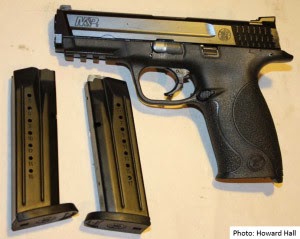
Smith and Wesson M&P 9mm Pistol Gun Review
In this article, I will provide a product review and range report on the Smith and Wesson M&P 9mm pistol as both a general equipment review and as information on an Aegis Academy rental gun. To set the proper context, let’s start with a little history.


History


In 1982, Glock took the firearms market by storm when it introduced a durable and highly reliable polymer framed pistol with its unique “safe action” trigger. Shortly after the Austrian Police adopted the 9mm Glock 17 as its duty sidearm, military and police forces around the globe either adopted or strongly considered this venerable platform. In the years that followed, many other pistol manufacturers rushed to regain this valuable corner of the firearms market.
For decades, Smith and Wesson revolvers and semi-automatic pistols had been long-favored sidearms for U.S. law enforcement. Adapting to law enforcement and consumer trends, S&W threw its hat in the polymer-framed pistol ring in 1993 with the “Sigma.” However, the Sigma design shared so many similarities with Glock that the subsequent lawsuit for patent infringement was eventually settled out of court in 1997.

Adapting to the ever expanding polymer-framed pistol market and aggressively seeking to enter into military contracts while also regaining a foothold in law enforcement circles, S&W introduced the M&P, or Military and Police, pistol line in 2005 with the M&P 9mm. Since then, they have expanded the line to include full-size, mid-size, compact, competition, shield, bodyguard and revolver models in 40 S&W, .45ACP, .357 Sig, .380ACP, and .22 Long Rifle. The M&P moniker has also extended to .357 Magnum/.38 Special M&P revolvers.

General Description


The S&W M&P pistols are polymer-framed, striker fired, short recoil operated, semi-automatic breech-locking pistols. This design incorporates an inertial striker safety which prevents the striker from moving forward and igniting the primer due to pistol momentum alone. This passive safety is disengaged only when the shooter depresses the trigger to initiate the firing sequence. The original models had no active or thumb safeties, but later models include this as an option. Other options include a magazine safety which prevents the pistol from firing while the magazine is removed as well as an integrated ignition system lock.

Smith and Wesson M&P 9mm Pistol Gun Review Breakdown
Other common design features include an integrated Picatinny rail to mount lasers or lights, ambidextrous slide lock, reversible magazine release, aggressive forward cut rear-cocking serrations, steel low mount “three-dot” or tritium sights, external extractor, loaded chamber indicator, and interchangeable back-straps to adjust to different hand sizes.

The action is a bit interesting. Most striker-fired pistols are considered single action since the slide recoil sets and locks the striker in a position ready to fire and the next trigger pull releases the striker to only move forward… thus single action. However, slide recoil in the S&W M&P sets and locks the striker 98% to the rear. The next trigger pull completes the remaining 2% movement to the rear before the sear releases the striker to move forward. Therefore, the S&W M&P is considered a striker-fired Double Action Only pistol. (Source: Smith and Wesson)

Ergonomically speaking, the bore axis is very low and an extended grip tang provides exceptional “guidance” toward a proper grip while drawing from the holster as well as recoil management during rapid fire.

S&W M&P 9mm Full Size Specifications


The pistol tested in this product review is the same model as the Aegis Academy rental gun. Actually, it IS one of the Aegis Academy rental guns. The Smith and Wesson web site lists this pistol’s attributes as follows:

  • Caliber – 9mm
  • Barrel Length – 4.25 inches
  • Sights – steel, low mount, three dot fixed sights
  • Trigger Pull – 6.5 pounds
  • Overall Length – 7.3 inches
  • Overall Height – 5.5 inches
  • Width – 1.2 inches
  • Sight Radius – 6.4 inches
  • Weight (empty) – 24 ounces
  • Finish – Black (frame: polymer; slide: melonite)
  • Capacity – two 17-round magazines


Analysis


I am very familiar with the M&P pistol line. I purchased a full-size M&P .45ACP in 2011 and used it extensively in USPSA (United States Practical Shooting Association) competitions in the Production Class through 2013. I have also used the full-size M&P 9mm on the range during instruction with Aegis Academy. In the following paragraphs, I’ll review the fit, function, and finances of the full-size M&P 9mm.

Fit – I found the full-size frame to be well suited to my large hands… even with the “Medium” back-strap insert installed. Aegis clients with smaller hands appreciated the option to “go down” one size and have the small back-strap insert installed. However, those with the smallest hands did occasionally have trouble gaining a “high grip” to ensure the tang sat snugly against the web between their thumb and forefinger. For most shooters, this pistol points naturally and the combination of the low bore axis and the extended grip tang made it easy to get the first shots on target while keeping the recoil manageable for rapid follow-up shots as well.

I personally appreciated the extended grip tang… especially when drawing from the holster. Again, with large hands, this is my main complaint with Glock pistols: overgripping the frame and getting “bitten” by the slide. Read more >>

Posted by Howard Hall

Monday, January 12, 2015

Shotgun Ballistics

Shotgun Ballistics This article answers a reader’s question and discusses shotgun ballistics.
“What about Shotguns and Shotgun Ballistics? The entire Ballistics Series was great and it was the first time that the science behind shooting was explained in a way that made sense. I’m considering a shotgun for home defense, so could you cover Shotgun Ballistics in one of your upcoming articles? Thank you.” – Brian in Temecula

Brian, thank you for the e-mail and for the opportunity to give the venerable shotgun the attention it deserves. Although there are many similarities between shotgun ballistics and rifle/pistol ballistics, the differences are significant enough to focus solely on the shotgun. What makes shotguns unique among other firearms is the wide variety of projectiles that can be fired from the same platform. This includes everything from a slug and a sabot round through buck shot, bird shot, and a number of less-than-lethal options. Since slugs and sabot projectiles are single solid projectiles, their ballistic characteristics are very similar to the pistol and rifle projectiles covered in the Ballistics Series. Therefore, I will focus the majority of this article on buckshot and birdshot.

Internal Ballistics

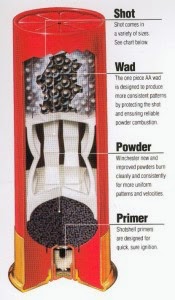
shotgun shell case cutaway If you recall, our discussion on internal ballistics focused on the characteristics of the firearm, the cartridge, and the initial actions in the firing sequence that occur within the confines of the firearm. For this discussion, we’ll start with the cartridges, known as shot shells, and their components :

Primer – similar to rifles and pistols, the shot shell primer is a small metal cup that contains an explosive mixture that, when struck by the firing pin, sends a small flame through the base to ignite the propellant.

Base – brass, steel, or aluminum, the base is a multi-function element that houses the primer, binds the hull, and provides rigidity to interact with the extractor and ejector to ensure firearm function.

Hull – polymer, plastic, or paper, the hull ensures the proper functioning of the shot shell by holding the individual components together behind a crimp. Once the propellant is ignited, the hull expands to the diameter of the chamber and ensures a sufficient gas seal to send the wad and shot forward.

Propellant – similar to rifles and pistols, the propellant, once ignited, produces the gas expansion required to fire the projectile(s).

Wad – Different from rifles and pistols, a shot shell requires a wad in order to: (1) provide a small internal compartment to contain the propellant and keep it separate from the shot or projectile; and (2) provide a buffer that absorbs shock and minimizes deformation of the shot as it accelerates from rest to initial velocity.

Shot – From a collection of very small to large lead or steel pellets through slugs, sabots, or less-than-lethal projectiles, the shot is a single or group of projectiles delivered from the firearm to the target.

Gauge and Chamber


shotgun-gauge Whereas rifles and pistols are designated by the caliber of the projectiles they fire, shotguns are designated by the shotshell gauge. While most shooters have heard the common gauges of 12, 20, 28, and .410, few know the origin of the term. A shotgun’s gauge is determined by the number of round projectiles of equal diameter that can be subdivided from one pound of lead. For example, a 12-gauge barrel was designed around the fact that one pound of lead could be divided into twelve 0.727-inch lead balls. The same methodology is true from the 4 gauge down to the 28 gauge. .410 is the exception to the rule since it was simply a determination of the diameter of the bore in fractions of an inch.

While the gauge determines the inside diameter of the bore, the chamber designation determines the maximum length of the cartridge. Most shotguns can chamber a cartridge of either 2-3/4 inches or 3 inches while others can handle a 3-1.2 inch shell. Together, the gauge and chamber determine the maximum volume of shot or size of the projectile.

Shot


Whether lead, steel, or another material, the shot is a volume of small diameter round projectiles. In the preceding section, we discussed how the gauge and chamber determine the maximum volume of shot a cartridge can contain, the diameter of the shot itself will determine how many projectiles can fill that volume. Ranging from #12 shot (at 0.05 inches per ball) to OOO, or triple-ought (at .36 inches per ball), each have their own application. Skeet shooters engaging fast-crossing targets at close range desire a large quantity of small pellets, so they typically choose a #9 shot. Conversely, trapshooters engage targets moving quickly away from the shooting position, so they choose either a #8 or a #7.5 shot with the requisite momentum to catch-up to and break the clay pigeon. The smaller shot is ideal for breaking clay pigeons or taking-down game birds without destroying their feathers or meat, but the small shot retains insufficient energy to take-down a larger game animal or subdue a felon. In these cases, the larger buckshot, slug, or sabot is chosen.

Internal/External Ballistics – Smooth-Bore, Forcing Cone, and Chokes


Break-open, pump, and semi-automatic shotguns share the same cycle of operations and functions as the rifles and pistols I covered in Internal Ballistics – Part I. Very briefly, as the firing pin strikes the primer, a small flame is sent through the base and into the hull, which ignites the propellant. The resulting rapid gas expansion pushes the plastic hull against the inside of the chamber causing a seal from which the wad and its contents can only push forward down the bore.

Shotguns, however, differ from pistols in rifles in three main areas: smooth-bore, forcing cone, and chokes. While some shotguns are manufactured with rifled bores, many more are manufactured with smooth bores. The rifled bore is designed primarily for the rifled slug and sabot rounds and produces the gyroscopic stability required to send the projectile to the intended target. Technically, birdshot and buckshot can be fired through a rifled bore, but the rifling will “spin” the plastic wad which will translate the centrifugal force to the shot and open the shot column into a “V,” leaving a large gap in the center of the shot spread. Therefore, birdshot and buckshot are meant to be fired through smooth-bores.

Since the chamber is larger than the bore, something needs to gradually “step-down” from the hull diameter to the inside diameter of the bore. This is the forcing cone. The length and shape of the forcing cone will affect the efficiency of the wad and shot traversing the length of the barrel. Too-short of a forcing cone can exert undue stress on the lead shot and cause deformation while too-long of a forcing cone may not generate enough pressure for sufficient initial velocity.

Once the wad and the shot exit the barrel, the volume of shot expands in both length and width. The size of the shot, shape of the forcing cone, and constriction provided by the choke work together and determine how much the shot column spreads as it travels down-range. As this shot column passes through a two-dimensional plane at any distance, it leaves a pattern. The following graphic demonstrates the spread of the shot pattern at different distances.... Read more

Posted by Howard Hall

Tuesday, January 6, 2015

Gun Rights, Personal Security and You


Gun Rights, Personal Security and YouIn many ways, 2014 had been an exhausting year filled with events that illuminate the triumph of the human spirit as well as tragedies that shake us to our core.  It is unfortunate that the impact of the tragedies often outweigh the buoying nature of the triumphs.  Regardless, near-instantaneous global digital connectivity, the 24 hour news cycle and an unprecedented access to information send us an endless stream of facts, figures and opinions on just about every major event.  Even when supposedly objective data is presented, extreme elements of both sides obscure any kernel of truth by manipulating, exaggerating or committing hyperbole to promote their particular point of view.  This can leave the average American citizen to ask two essential questions: “What should I believe and what can I do about it?”


Gun Shooting, Gun Rights debate


In terms of triumph, tragedy and longevity, few social and legal issues can match the Gun Rights debate.  Rather than analyzing the merits of both sides of this long-standing issue, I will focus on the foundation of the Gun Rights debate, place it in the current context of personal security, and conclude with some thoughts on personal actions available to you.

The Gun Rights Debate


The Gun Rights debate traces its roots back to the ratification of the U.S. Constitution in 1788.  The original Constitution focused on establishing and delineating the powers of our three branches of government (executive, legislative and judicial), but made no specific mention of gun rights.  Over two hundred years of hindsight make the ratification process seem clean and straight-forward.  However, Federalist and Anti-Federalist factions hotly debated each and every issue within the document.  As a result, the Constitution was founded on extraordinary compromise, but many issues were left unresolved.  In order to get the Constitution ratified in 1788, the framers agreed that the document was a foundational “start” to the process, but would continue debates on contentious issues that would be amended at a later date.  In 1791, the first 10 amendments were encapsulated into the Bill of Rights.  The Second Amendment, stating: “A well-regulated Militia, being necessary to the security of a free State, the right of the people to keep and bear Arms, shall not be infringed,” was included in the Bill of Rights.

Since then, any number of events from the Civil War through the Cold War and
The Second Amendment of Gun Rights
some of our current tragedies stress our understanding of those 27 words.  In general, there are three different interpretations of the Second Amendment.  The first interpretation focuses on the initial clause and believes that it only authorizes each state the right to maintain a militia.  The second interpretation expands the viewpoint of the first by purporting that only individuals who are part of a state militia may keep and bear arms.  The third interpretation strongly focuses in the words as written, “the right of the people to keep and bear arms shall not be infringed.

Today, these differing interpretations are adopted by the political parties that align themselves with their belief in which entity is most responsible for ensuring and providing public security.  One extreme believes in a very powerful government that provides collective security supported by citizens who willingly submit individual rights to have their security provided for them.  The other extreme believes in a limited government that provides only the level of security required to protect from external attack while ensuring the rule of law supported by those who believe in strong individual rights and the right to provide for one’s own security.

So, where do you fall within this continuum?


If there was ever a metric that was hard to define, it is “American Popular Opinion.”  From our country’s foundation through the current day, there have been extreme views and thousands of intermediate variations on “what is right or what is the collective good?”  In the last 30 years, we have seen public or popular opinion in regard to gun rights vacillate and even spike in relation to major events.  While lawful use of firearms in self-defense tends to be woefully under-reported, unlawful use of firearms tends to be grossly over-reported.  In the wake of major events, parties on both extremes entrench in their respective ideological positions while the flames are fanned by an equally ideological media.  The truth, of course, can be found obscured somewhere in-between. Read More >>

About Author – Howard Hall


Howard Hall “Range Master at Aegis Academy – has served for nearly 20 years in the Marine Corps. He has served as a Platoon Commander, Company Commander, Battalion Executive Officer, Regimental Operations Officer, and Battalion Commander. He has multiple combat tours to include serving as a military transition team member in Fallujah. He is an NRA Certified handgun instructor and holds numerous Marine Corps training credentials. An active competitor in action pistol (United States Practical Shooting Association), long range rifle (NRA F-Class), and shotgun (Amateur Trapshooting Association, National Skeet Shooting Association), Howard has earned numerous accolades and medaled during DoD competitions with the 1911 platform in bulls-eye shooting.


Friday, December 19, 2014

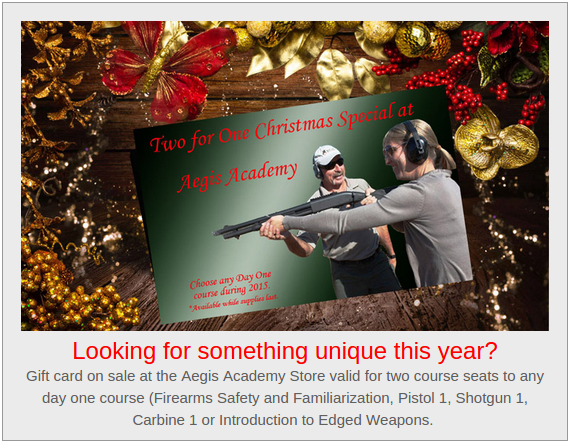
Christmas Gift Card for any Firearms Safety Course that your loved ones will remember

Why not take a little step towards building safe and happy community for our loved ones this Christmas!

Instead of buying lose tangible gifts, get your friend or family a Christmas Gift Card to any Day one Gun Safety Course and show them how much your care and want them to be safe!

Take advantage of this two for one offer to any Day one course offered on the schedule in 2014 or 2015 at Aegis Academy facility located in San Diego. Day one Course are the Firearms Safety and Familiarization Course, the Pistol, Shotgun or Carbine One courses and the introduction to edged weapons. Confidence, experience, capability and independence are what this nation is built on.

Two for One Christmas Special at Aegis Academy - Gift card on sale for any day one course Firearms Safety and Familiarization, Pistol 1, Shotgun 1, Carbine1, or Introduction to Edged Weapons.


Voucher Expires Dec 31, 2015. Attendee's must attend the course together, and each voucher is good for two course seats.

Click here to purchase 2014 Christmas Special Gift Voucher to any Day One Course!

Tuesday, December 16, 2014

Improving your trigger control one finger at a time

Earlier this year, I added yet another part of my aging body to the list of hurts and complaints. My wrists began to feel stiff and painful, and I had to admit that Carpal Tunnel Syndrome apparently is a real thing. I am already challenged by a set of appendages that are notoriously short with rather svelte paws. I have significantly damaged both hands in my career, my left hand goes numb regularly from scar tissue and the fingers can barely turn a key. My dominant hand was broken twice and I am sure a career playing piano is not going to be in my future. You may be asking yourself why is this relevant to firearms?

Our fingers, especially their ability to smoothly pull the trigger without disturbing the sights, are hugely important in becoming accurate shooters. Unless you’re a rock climber or practicing martial arts, chances are you do not actively work out your fingers. When I complained of stiffness and pain to my yoga teacher, she gave me some great suggestions that I found improved my trigger control. A few simple exercises can help increase dexterity and isolate each of the fingers from each other. A small advantage maybe, but any advantage you get in a gunfight is one to use. I am not discussing grip itself, hand position or trigger finger placement. All of which could be articles in themselves. The goal is to isolate the trigger finger itself from the whole.

Isolating our trigger finger from the rest is difficult. Our hands are poorly designed as tools for fine motor skill, especially under stress. Those who regularly practice complicated tasks like typing (at least for me) or playing instruments already have accomplished the same idea. A few processes are involved; one is the process of Myelination, the other is the tendon sheath keeping the tendons themselves lubricated and flexible. I am not a doctor, or even a manicurist, so my explanation focuses on how the tendons affect us. To read about Myelin and how it affects motor learning, click on the link. The tendons on the back of our hands all come together at the wrist in an area called the Carpal Tunnel, and in simple terms since they are bunched together, the signals telling you to move one finger cross over to the other digits.

We like to think that our fingers are precision tools, but only in certain ways. While they work in concert with the thumb individually to hold small objects, they are somewhat less precise with each other. When we move one finger, the signals cross and the other fingers move as well. Age, injury and lack of physical exercise can compound this. Often this is caused by inflammation of the tendon sheaths surrounding each tendon. The inflammation causes lack of lubrication on the tendon and restricts flexibility. Additionally, power is generated in the forearms so if we tense there it translates to the fingers. Try this for yourself, hold your hand vertical with all the fingers extended, but slightly relaxed, Try just curling your pointer or trigger finger and see how much the other fingers move. You can also feel your forearm flex. Read More >>


Posted by Aegis Academy Staff

Thursday, December 4, 2014

Terminal Ballistics – Part II

Terminal Ballistics
Welcome back to the second and final installment in the Terminal Ballistics series, which will also complete the Ballistics Series. In Terminal Ballistics I, we covered key terminology and highlighted the common goal of hunters, law enforcement, and home defenders… to incapacitate game animals or felonious assailants with as few shots as possible. We also covered the two methods that bring about incapacitation: a well aimed shot to the Central Nervous System (Medulla Oblongata or the upper spinal cord) and severe blood loss. In this article, we will cover projectile characteristics, best practices, and conclude the series.

Terminal Ballistics in Hunting and Personal Defense


With a wide variety of options in caliber, construction, and velocity, which combination is best? That is certainly a loaded question… pun fully intended. Short of providing overwhelming destructive force, which does not serve the hunter very well and is not typically an option for the home defender, the problem lies in having many options to address an even wider variety of possible conditions. Within these options lie a number of trade-offs. I’ll explain below.
As we’ve covered in the previous article, the most reliable method to take-down a game animal or end a felonious assault is to place an incapacitating shot into the central nervous system. In order to do this, a projectile of any caliber must possess sufficient velocity to penetrate the skin (animal or human), pass through layers of muscle and tendon, and destroy or at least interrupt the vital organs. Although it is often dismissed as an effective cartride, even a small .22 caliber long rifle projectile can accomplish this desired effect. However, as we’ve discussed at length, the central nervous system represents a disproportionately small area of the body in which this incapacitating shot can be taken. All other shots rely on severe blood loss, skeletal immobility, and shock.

All other things being equal (velocity, projectile construction, mass, etc.), penetration is essential to reach vital areas. This is where it can get confusing and the trade-offs take place. Since most projectiles are constructed with a combination of dense cores covered by softer metal jackets, small caliber projectiles will have a greater sectional density and thus require less velocity to penetrate. Robert Rinker equates this to comparing the force required to thrust both a small pin and a construction nail through remarkably pliable flesh. With greater sectional density and smaller diameter, the pin will require less force (momentum) to overcome the tensile resistance of the skin.

OK… so small calibers penetrate more easily. However, if it does not hit the small zone in which rapid incapacitation can occur, the small caliber projectile at high velocity can penetrate and pass through (often called over-penetration), leaving only a small permanent wound cavity which fosters only moderate blood loss. This can result in a lost game animal or an assailant who can continue the attack.

A projectile that expands on impact is beneficial since it creates a permanent wound cavity larger than the original caliber while maintaining the momentum of its original weight. However, rapid expansion hinders penetration.

So, both the hunter and home defender need to start with the terminal ballistic effect desired and work backward to develop a solution in terms of projectile construction, velocity, and firearm type. Hunters know their game type and relative distances from which they will be taking the shot. External Ballistics Part III introduced velocity measurements and how to calculate residual velocity at different ranges. Home defenders know that the majority of pistol shots will be taken at roughly 20-25 feet. My recent article on Handgun Velocity demonstrated the effects of barrel length and temperature on velocities.

Armed with this knowledge in mind, here are some of the differentiating characteristics of projectile construction. Read More >>

About Author - Howard Hall


Howard Hall "Range Master at Aegis Academy" - has served for nearly 20 years in the Marine Corps. He has served as a Platoon Commander, Company Commander, Battalion Executive Officer, Regimental Operations Officer, and Battalion Commander. He has multiple combat tours to include serving as a military transition team member in Fallujah. He is an NRA Certified handgun instructor and holds numerous Marine Corps training credentials. An active competitor in action pistol (United States Practical Shooting Association), long range rifle (NRA F-Class), and shotgun (Amateur Trapshooting Association, National Skeet Shooting Association), Howard has earned numerous accolades and medaled during DoD competitions with the 1911 platform in bulls-eye shooting.

Tuesday, December 2, 2014

Terminal Ballistics – Part I

Understanding Bullet Impacts

Terminal Ballistics
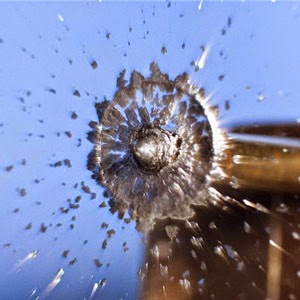
Terminal Ballistics - Part I is the first in a two-part series which will begin to conclude the Ballistics Series by introducing the principles within Terminal Ballistics and focus on the various aspects of projectile impacts on target and their immediate effects. Leveraging the key concepts of projectile flight and construction, momentum and kinetic energy introduced earlier in the ballistics series, this article will illuminate some scientific facts in regard to the terminal effect of firearm employment for hunting, law enforcement and personal defense while also debunking some commonly-held myths. In researching this topic, I've relied heavily on authoritative sources such as Robert Rinker's "Understanding Firearm Ballistics, 6th edition," and the Federal Bureau of Investigation's 1989 report titled "Handgun Wounding Factors and Effectiveness."

Overview

Whether for recreation, competition, training, hunting or personal defense, this ballistic series has focused on the myriad of aspects that affect a projectile's flight to target in order to provide a better understanding and help you choose the right firearm/ammunition combination to safely and consistently place your shots on target and achieve the desired ballistic effects. From the mechanical interactions internal to the firearm to the atmospheric and physical conditions that affect projectile flight, this series has provided information necessary to harness mechanical precision into shooter accuracy. Now, we will discuss projectile impacts on target.

Since recreational and competitive shooters are primarily focused on measuring the effectiveness of their skill and technique by scoring shots on paper, cardboard, or interactive targets, terminal ballistics is simply a factor of hitting the target for score. For hunters, military/law enforcement, and personal defenders, on the other hand, the projectile's ultimate effect is eminently important since it is the sole reason for weapon employment. Although the conditions for weapon employment are much different in these latter cases, the desired result is the same… rapid incapacitation with as few shots fired as possible!

This rapid incapacitation is a factor of shot placement combined with velocity, kinetic energy, projectile weight, projectile shape and construction, caliber, and range to target as well as the nature of the target itself. In order to move forward with the discussion, we need to first discuss some terms and concepts common to both hunting and personal defense.

Terms and Concepts

  • Caliber - diameter of a projectile
  • Mass - in the most general terms, this is the weight of the projectile
  • Velocity - this is the instantaneous speed at which the projectile is moving. Projectiles exit the firearm bore with an initial velocity which immediately begins to slow down due to air resistance and drag.
  • Ballistic Coefficient - based on the shape and construction of the projectile, this number describes how well the projectile travels through the air and preserves its velocity. Read More »

About Author


Howard Hall - Range Master


Howard has served for nearly 20 years in the Marine Corps. He has served as a Platoon Commander, Company Commander, Battalion Executive Officer, Regimental Operations Officer, and Battalion Commander. He has multiple combat tours to include serving as a military transition team member in Fallujah. He is an NRA Certified handgun instructor and holds numerous Marine Corps training credentials. An active competitor in action pistol (United States Practical Shooting Association), long range rifle (NRA F-Class), and shotgun (Amateur Trapshooting Association, National Skeet Shooting Association), howard has earned numerous accolades and medaled during DoD competitions with the 1911 platform in bulls-eye shooting.